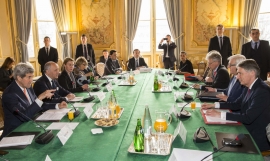
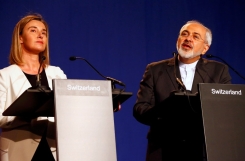
The United States made clear on Monday that sanctions on Iran would have to be phased out gradually under a nuclear pact and President Barack Obama poured cold water on an Israeli demand that a deal should depend on Tehran recognising Israel.
"The notion that we would condition Iran not getting nuclear weapons in a verifiable deal on Iran recognising Israel is really akin to saying that we won't sign a deal unless the nature of the Iranian regime completely transforms," Obama said in an interview with National Public Radio (NPR).
"That is, I think, a fundamental misjudgement... We want Iran not to have nuclear weapons precisely because we can't bank on the nature of the regime changing," he said.
Meanwhile White House spokesman Josh Earnest said there was no ambiguity about the US demand that sanctions on Tehran be lifted in phases under a final deal, but details still had to be negotiated.
"It has never been our position that all of the sanctions against Iran should be removed from Day One," he told a briefing.
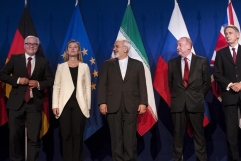
The White House is working aggressively to convince US lawmakers and other critics to embrace the framework agreement reached on Thursday between Iran, the United States and five other major powers.
The framework was a major step toward a final deal but did not include an agreement on the timing and scope of sanctions relief. Many other issues also must be hammered out before the end-of-June deadline for a final accord.
Iran's negotiators have interpreted the outline differently, saying sanctions would be lifted immediately once an accord is signed.
Earnest said Washington would want to see sustained compliance by Iran first and Iran would be more likely to comply if it knew sanctions could be applied again.
US Energy Secretary Ernest Moniz said on Monday the differences in portrayals of the deal by both sides were not disputes over content but were related to what each side chose to emphasise.
"There's no doubt that right now there's a different narrative, but not in conflict with what's written down," Moniz said.
A key US ally, Saudi Arabia, sounded a note of caution on the agreement.
Adel al-Jubeir, the Saudi ambassador to Washington, told reporters the oil-rich kingdom wants to see more details on the restrictions on Iran's nuclear work, nuclear inspections, and when international sanctions on Tehran would be lifted.