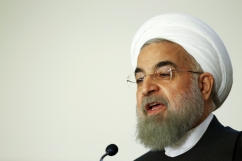
Iran now able to access $100 billion of its frozen assets under nuclear agreement

Iran has announced that it has already gained access to the more than $100 billion worth of its frozen overseas assets as part of the nuclear agreement signed with world powers last summer.

"These assets have fully been released and we can use them," Iran government spokesperson Mohammad Bagher Nobakht said in comments posted on the website of state-run Press TV.

"Much of the money belongs to Iran's central bank and National Development Fund,'' he said, adding that Iran will not bring all the money back because it can be spent on purchasing goods.

According to Nobakht, much of the money that came from international sales of Iranian oil had been piling up in banks in China, India, Japan, South Korea and Turkey. Those countries have been holding the funds in escrow since tighter sanctions were implemented in 2012.

Central bank official Nasser Hakimi, meanwhile, said nine Iranian banks are now reconnected to SWIFT, a Belgian-based cooperative that handles wire transfers between financial institutions, according to Iran's semi-official ISNA news agency.

Currently, reports say no foreign banks operate in Iran, and ATMs there are not yet linked to the global system.

With the lifting of sanctions and access to funds now, Iran is expected to have an economic breakthrough and sell crude oil more freely. Iran has the fourth largest oil reserves in the world, reports say.

Mohsen Jalalpour, the head of Iran's Chamber of Commerce, said on state TV Monday that Iranian businessmen are already able to open letters of credit for transactions in other countries.

Iran's landmark deal with six world powers signed in July 2015 limit its sensitive nuclear activities for more than a decade in return for the lifting of crippling sanctions. But many people—including Israeli officials, as well as those from Arab states like Saudi Arabia and the United Arab Emirates—believe Iran will use these funds to pay its terror proxies such as Hezbollah or the Houthi rebels in Yemen, which could in turn destabilise the Middle East.

Furthermore, officials and analysts fear that Iran could also use the money to develop its ballistic missile programme.


related articles
With sanctions lifted, Iran quickly bares plan to build 2 nuke plants with help from Russia and China

The Islamic Republic is set to start construction of two new nuclear power plants in the "near future" with the assistance from Russia and China, the head of Iran's Atomic Energy Organization announced Tuesday.

Iran\'s President Rouhani claims boosting Middle East economy is the way to beat terrorism
Iran's President Rouhani claims boosting Middle East economy is the way to beat terrorism

Iranian President Hassan Rouhani put his country forward his country as a regional trade hub and pillar of stability.

Head of Syrian Catholic Church slams Italy for covering nude statues during Iranian president\'s museum visit
Head of Syrian Catholic Church slams Italy for covering nude statues during Iranian president's museum visit

The head of the Syrian Catholic Church has expressed concern over the decision of Italian authorities to shield nude statues during the visit of Iran President Hassan Rouhani, saying it is [Western] culture that should have been respected.

Pastor Saeed Abedini denies wife\'s sexual abuse claims but admits their marriage is in \'great stress\'
Pastor Saeed Abedini denies wife's sexual abuse claims but admits their marriage is in 'great stress'

Pastor Saeed Abedini was finally released from his prison cell in Iran, only to be greeted by bad news when he got home. Apparently, his wife Naghmeh filed a domestic relations case against him and refused to remain in his presence when he got to the Billy Graham Training Center in North Carolina.

News
Faith in difficult times: lessons from 1930s Britain

Architectural historian Steven Brindle talks to Christian Today about the faith that shaped 1930s Britain, the churches that supported struggling communities and what lessons the decade might have for us today.

Campaign aims to mobilise 500,000 Christians for Christmas outreach

Shine Your Light is aiming to mobilise half a million Christians to share the gospel with five million people across the UK this Christmas, with more than 2,000 churches already signed up, organisers say.

The Church of England should repent for previous calls to ban 'conversion therapy'

The Church of England's uneasiness about the government's ‘conversion practices’ bill is a perfect lesson in the old adage, 'be careful what you wish for,' writes Dr Martin Davie.

Leaked Home Office report links 'Christian extremism' to traditionalist beliefs and immigration concerns

An internal Home Office report lists concerns about immigration, multiculturalism and changing social values among the characteristics associated with what it calls "Christian extremism", it has been reported.