Head of Syrian Catholic Church slams Italy for covering nude statues during Iranian president's museum visit

The head of the Syrian Catholic Church has expressed concern over the decision of Italian authorities to cover nude statues during the visit of Iranian President Hassan Rouhani, saying Western culture should have been respected.

"This is our culture. If you [Rouhani] don't want to see it, close your eyes!" Patriarch Youssef III Younan told a media conference in Rome on Thursday, according to the Washington Post.

The patriarch's statement added to the overwhelming reactions and memes from critics mocking Italy's decision to cover up nude statues at Rome's Capitoline Museum with big white boxes and large panels when the Iranian president visited the facility last week.

The decision was condemned by critics as "incomprehensible," "ridiculous," and "submission" to principles that are against Western culture.

Younan spoke about the persecution experienced by Iraq and Syria's Christians, saying the Catholic majority in Italy should have taken a stronger stance during Rouhani's visit.

"This gives a lot of pain to us Christians who have remained, seeing our brothers, who are ready to forget everything for reasons of humanitarian interests, or opportunism,'' he said, noting that many Christians have been targeted by Salafist militant groups in recent years.

The patriarch also talked about the havoc and instability in the region triggered by the U.S. invasion of Iraq in 2003, blaming the U.S. action for much of his constituency's present suffering. Iraqi Christian priests have made similar claims.

"Western media speak about the 'monstrosities' of Assad, saying he's killed 100,000 Syrians," Younan said. "But they don't speak about the 1 million people who died in Iraq as a result of the allied military intervention in 2003. It's all been forgotten."

Speaking on Jan. 27 in Rome, Rouhani said Tehran had not contacted Italian officials to ask for the statues to be covered up. "This issue is something journalists and the press like to discuss,'' he said.

Some Iranians, meanwhile, have likened Italy's decision to cover up nude statues to Iran's state censorship, including tough Internet censorship that targets tens of thousands of websites.

"Smart filtering of statues during #Rouhani's trip to #Italy," reads the tweet that includes a photo of the nude statues covered in the page that Iranians see when they try to access banned websites, according to news reports.


related articles
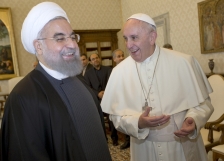
Pope meets Iranian president, asks him to help stop Middle East terrorism

President Rouhani is on a four-day visit to Italy and France aimed at building diplomatic and commercial relationships.

Iran\'s President Rouhani claims boosting Middle East economy is the way to beat terrorism
Iran's President Rouhani claims boosting Middle East economy is the way to beat terrorism

Iranian President Hassan Rouhani put his country forward his country as a regional trade hub and pillar of stability.

Italy government draws flak after covering nude statues at museum in bid not to offend visiting Iranian president

Iranian President Hassan Rouhani's official visit to Rome was marred with some controversy after Italian authorities covered up nude statues exhibited at a world-famous museum in the country ahead of his visit.

Holocaust never happened, Iran's Ayatollah Khamenei claims on Remembrance Day

As Europe and some parts of the world commemorated the Holocaust Memorial Day recently, Iran's Supreme Leader Ayatollah Khamenei uploaded a video to his official website claiming that the Holocaust never happened.

\'Virtually impossible\' now to detect ISIS from among refugees entering Europe, says British intel official
'Virtually impossible' now to detect ISIS from among refugees entering Europe, says British intel official

With the proliferation of fake Syrian and Iraqi passports used by terror group Islamic State (ISIS), it is "virtually impossible'' now for security officials to detect potential terrorists among the refugees, according to a senior British intelligence official.

News
Faith in difficult times: lessons from 1930s Britain

Architectural historian Steven Brindle talks to Christian Today about the faith that shaped 1930s Britain, the churches that supported struggling communities and what lessons the decade might have for us today.

Campaign aims to mobilise 500,000 Christians for Christmas outreach

Shine Your Light is aiming to mobilise half a million Christians to share the gospel with five million people across the UK this Christmas, with more than 2,000 churches already signed up, organisers say.

The Church of England should repent for previous calls to ban 'conversion therapy'

The Church of England's uneasiness about the government's ‘conversion practices’ bill is a perfect lesson in the old adage, 'be careful what you wish for,' writes Dr Martin Davie.

Leaked Home Office report links 'Christian extremism' to traditionalist beliefs and immigration concerns

An internal Home Office report lists concerns about immigration, multiculturalism and changing social values among the characteristics associated with what it calls "Christian extremism", it has been reported.