Generating economic growth in the Middle East is crucial to defeating extremism, Iranian President Hassan Rouhani said on Tuesday, putting forward his country as a regional trade hub and pillar of stability.
Rouhani is on a four-day trip to Italy and France, looking to rebuild Iranian relations with the West some two weeks after financial sanctions on Tehran were rolled back following the implementation of its nuclear deal with world powers.
Italy announced some 17 billion euros ($18.4 billion) of business deals with Iran on Monday. Mega contracts are also in the offing in France, reflecting EU countries' keenness to cash in on the diplomatic thaw with the Islamic Republic.
Underscoring the growing warmth, Rouhani said he expected Italian Prime Minister Matteo Renzi to visit Iran in the coming months to help boost bilateral economic alliances.
"We are ready to welcome investment, welcome technology and create a new export market," Rouhani told a business forum on the second day of his visit to Rome, saying Iran had ambitions to develop its own economy after years of curbs and hardship.
"Under the new conditions, we want to export 30 per cent of what we produce in Iran," he said, calling for rapid investment in "the most secure and stable country in the region".
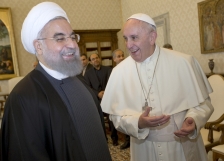
Later, during a 40-minute private meeting in Pope Francis's private study, the pontiff asked Rouhani to work with other Middle East states to promote peace and stop the spread of terrorism and arms trafficking in the region.
Italy rolled out the red carpet to Rouhani and his 120-member delegation of business leaders and cabinet ministers, seeing Shi'ite Muslim Iran as a possible partner in the international coalition against Sunni Muslim Islamic State insurgents.
"If we want to combat extremism in the world, if we want to fight terror, one of the roads before us is providing growth and jobs. Lack of growth creates forces for terrorism. Unemployment creates soldiers for terrorists," Rouhani said.
"Strategic alliance" eyed
Many Western nations accuse Iran of funding various militant groups that are on US and EU terror blacklists. Despite Iran's deal with world powers to curb its disputed nuclear programme, the United States is keeping some of its financial sanctions in place because of its links to organisations such as Hezbollah.
Sunni arch-rival Saudi Arabia – alarmed and angry over Iran's coming in from the diplomatic cold, especially its newly pragmatic contacts with the United States – sought to deflate hopes that Tehran would be a bonanza for foreign investors.
"They all have these bright euro or dollar signs in their eyes about Iranian business opportunities, but whoever is going to do business in Iran will have to do it with their money and not Iranian money," Prince Turki al-Faisal, earlier the Saudi intelligence head and ambassador to Washington, said on Tuesday.
But any such criticism barely registered in Rome, where the economy continues to struggle after a three-year slump and where the government is eager to welcome Iran as a potentially positive force in an increasingly fragmented Middle East.
"We are not looking at simple reactivation of our cooperation with Iran, but rather a comprehensive relaunch of a strategic alliance," Italian Foreign Minister Paolo Gentiloni told the business conference.
To spare the leader of the Islamic Republic possible offence, the Italians even covered nude Roman statues in the Capitoline Museums where Rouhani met and spoke with Renzi on Monday evening.
Among the deals signed on Monday were a $4 billion contract for oil services group Saipem, up to 5.7 billion euros in contracts for steel firm Danieli, up to 4 billion euros of business for infrastructure firm Condotte d'Acqua, 4 billion euros for rail and road company Gavio and 400 million euros for planes from Finmeccanica.
Industry Minister Federica Guidi told la Repubblica newspaper that the total value of the contracts could exceed the 17 billion euros initially indicated by the government.
Two large Italian business delegations went to Tehran soon after the nuclear deal was agreed last year. Another such group is scheduled to visit Iran from February 8 to 10.