First thing tomorrow morning, Pope Francis will leave Rome's Fiumicino airport for one of the most controversial visits of his Papacy. Much US coverage has glossed over it, but before arriving on American soil next Tuesday, to be greeted airside in Washington by President Barack Obama, he will spend three days in Cuba, just one day fewer than the four he will spend in the United States. He might even meet Fidel Castro, depending on the frail former president's health.
In spite of his reconciliatory language, and his desire to soften the harshness with which the teaching is so often delivered, Pope Francis is in pectore as conservative on the Catholic Church's moral teaching as his predecessors Pope Benedict XVI and Pope John Paul II.
As is so often the case with Latin American prelates, his social thought is a different matter. The grey areas between the two, on such as marriage and divorce, when social justice crosses over with moral teaching, will be the most contentious at October's Synod on the Family. But this will not trouble him in Cuba, the largest island in the Caribbean and nearly 100 miles south of the United States.
While by no means a class warrior, he certainly has more in common with Jeremy Corbyn and Barack Obama than he does with David Cameron or any of the Republican presidential contenders. Who would not say a million rosaries for the chance to listen in on a conversation between Pope Francis and GOP favourite Donald Trump? In Cuba, the spiritual battle lines will not be so much over life and family issues, as over God and church. Of all the Popes in recent history, Pope Francis is the one most likely to be a catalyst for Catholic revival in this officially secular and once atheistic state.
In a briefing on the visit for Catholic Voices, the Catholic writer Austen Ivereigh, author of The Great Reformer, the most authoritative Pope Frances biography to date, spoke of the significance of the historic breakthrough earlier this year when diplomatic ties between Cuba and the US were restored. Cuba president Raúl Castro has praised Pope Francis personally for brokering this restoration. And in a broadcast today on the eve of his visit, the Vatican made it clear that the Pope is hoping one fruit of his visit will be a lifting of the US commerical and economic embargo, referred to in Cuba as a blockade, which has been in place since soon after the 1959 revolution. The US remains strongly opposed to lifting the embargo without an improvement in Cuba's human rights record. The Pope, who himself knows many of the senior politicans in Cuba, still a majority Catholic country in spite of the years of official atheism, will certainly try to broker a softening on both sides, both in his public speeches and behind the scenes. In a taste of the tone he will adopt, he also sent a personal video message in which he spoke of Christian hope and love, a message in which his understanding of the dificulties of poverty and deprivation under the decades of such an embargo shines through: "He knows better than anyone else what everyone needs, what are your longings, what is your deepest desire. He never abandons us, and even when we don't act as he expects us to, he said, Jesus is always at our side, ready to welcome us, to comfort us, to give us a new hope, a new opportunity, a new life."
Pope Francis is in a unique position to help with this intractable embargo. As incoming Archbishop of Buenos Aires back in 1988, he accompanied Pope John Paul II on his historic visit to Cuba. It was after this visit that Christmas was restored to Cuba and religious freedom has slowly been increasing since. In the book Bergoglio wrote afterwards, Dialogue between John Paul II and Fidel Castro, he noted an uncomfortable truth that many Americans in power still do not want to hear: the reasons for the embargo have long since been superseded. Pope Francis, who has always been a Latin American nationalist, will now be able to speak to modern-day Cuba as none other could, and take the heartfelt pleas he will hear direct to President Obama, while also speaking truth to Castro in his bid to nurture change.
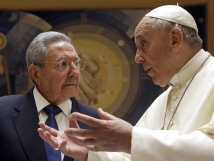
And it is not unreasonable to hope that there could be movement on both sides. Significantly, Pope Francis met Raúl Castro earlier this year at the Vatican. Castro said afterward he was so impressed "that if the Pope continues to talk as he does, sooner or later I will start praying again and return to the Catholic Church – I am not kidding."
The Pope is travelling to Cuba as a "missionary of mercy". There is much to lose and gain on all sides. Progress will only be made if forgivenss and reconiliation can be embraced and fear forsaken. Spiritual imperatives are not always the easiest to embrace in matters of power and state but if anyone can use these to bring about change, it is the present Pope.