On 11 November 2015, Angola celebrates the 40th anniversary of its independence. Since its emancipation from 400 years of Portuguese rule in 1975, the southern African nation has seen many ups and downs.
On one hand, the rapid expansion of its economy and middle classes; on the other, a violent 27-year-old civil war, a widening poverty gap and increasingly limited space for critical voices in the public arena.
Angola is one of the world's fastest growing economies and Africa's second largest oil producer. The president's daughter, Isabel dos Santos, is Africa's first female billionaire. Yet Angola remains one of the world's poorest nations.
Two-thirds of people survive on less than US $2 a day, while access to healthcare and safe water sources are still not universal. Meanwhile, some of the poorest citizens live under the constant threat of being driven off their land to make room for new building developments, particularly in the capital Luanda where space is a premium.
It is in this context that the Church in Angola is promoting the country's most marginalised communities. At the forefront of this work is the Council of Christian Churches in Angola (CICA), an ecumenical group supported and funded by international development NGO Christian Aid.
"Much was destroyed in the civil war: after independence, people faced economic crises and many families were displaced," says CICA's General Secretary, the Rev Deolinda Teca. "The Council of Christian Churches in Angola was launched in 1977, two years after the war began, to bring churches together to respond to the challenges people were experiencing."
The devastating conflict started immediately after independence, and claimed 500,000 lives. "During the war, the Church was a voice for the voiceless, crying out for peace and reconciliation," explains Rev Deolinda, who is a pastor of the Evangelical Reformed Church of Angola and former head of CICA's Justice and Peace Department.
Since the 1980s, CICA has worked close with Christian Aid to develop its work on peacebuilding and conflict-resolution. They also tackle themes such as gender-based violence, human rights, governance and HIV. As a faith organisation, they have a key role to play in the country's development, Deolinda says.
"The government and civil society in Angola see the Church as a credible voice that can make an impact on peacebuilding, reconciliation, human rights, citizenship, and can even improve moral and ethical values. The Church has a big responsibility: we have an opportunity to be visible and credible; and we already know how to mobilise people."
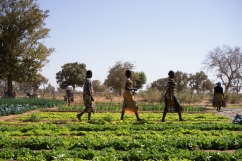
As part of its efforts to bring about change, CICA runs a 'good governance and social monitoring' project, working alongside member churches to find out first-hand the most pressing social needs within deprived neighbourhoods. Last month, in collaboration with the Catholic Church in Angola, CICA launched its annual report documenting the findings and suggesting how public funds can be best invested to help those in poverty.
"Although the country has made progress, certain challenges remain, including on issues like water, health, education and electricity," Deolinda says. "As CICA, we want our [development] initiatives to meet the specific needs and priorities of communities. Even the government needs to know what's happening on the ground. So that's why we go into the communities to hear first-hand what's going on in the villages: we don't work in isolation."
The report makes recommendations for churches, NGOs and government, including calls to prioritise school construction in remote areas; broaden literacy programmes; repair roads and improve health services, particularly maternity facilities.
In this year's report, CICA also urges churches and civil society groups to promote gender equality. As the only woman to hold the post of CICA general secretary, and arguably Angola's foremost female Christian leader, this is an issue close to Rev Deolinda's heart.
"It's a big challenge to be the first woman in the leadership role at CICA," she says. "Some of our member churches don't ordain women and some don't allow women to preach on Sundays. So within the Council we have been trying to balance the different views on women in leadership."
"But women in Angola are very, very strong. Pastors know that if you don't have women in the church, the church will be empty!" she adds, with a knowing smile.
Under Rev Deolinda's headship, CICA has continued to put gender justice and equality firmly on the public agenda, and has recently produced a study on gender within the Church in Angola. This month it will bring together Angola's female theologians to discuss women in leadership, while last month it helped organise a conference near Luanda where the theme was the social influence on women.
"We are promoting female leadership," explains Rev Deolinda. "We want to encourage Angola's women not to be afraid, but to be confident with their talents. We want them to know that if you're confident then you can do more: within your house, within the church, within society."
Despite being full of poise of confidence, Deolinda nevertheless embraces a collaborative style of leadership which, she says, is counter-cultural in a society where authority figures can be reluctant to share power.
"In my work, I can send colleagues to meet government or community representatives without me. I delegate, but it's not the cultural norm. When I started this role, people kept telling me, 'Please don't delegate, go yourself'. But when you are in a position of leadership, it's important to encourage and empower others so that when you leave, the work can continue without you."
As Angolans celebrate today's Independence Day milestone, Rev Deolinda's words are a timely reminder that the best style of Christian leadership relies not on independence, but on partnership, collaboration and empowerment.
Tomilola Ajay is a press officer for Christian Aid.