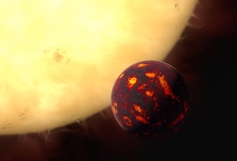
Is hell a place on Earth, in the underworld or just a state of mind? Wherever it is, space scientists recently discovered an alien planet that seems to be close to what hell may look like.
An international team of astronomers headed up by the University of Cambridge spotted a "super-Earth" called 55 Cancri-e, which is located 40 light years away from our planet. Its face is mainly a sea of molten lava.
This hellish alien planet has a surface temperature of 2,400 degrees Celsius or 4,352 degrees Fahrenheit—half as hot as our sun.
The researchers also discovered that 55 Cancri-e is tidal-locked, meaning its molten lava side is permanently pointing toward the sun-like star it is orbiting in the constellation Cancer.
What makes this alien planet even more interesting is the fact that it should not be as hot as it is, given its great distance to its parent star. This made the astronomers call 55 Cancri-e an out-of-place "hotspot."
Also noteworthy about 55 Cancri-e is a bright streak that can be found at about the halfway point between the point closest to the star and the night side. Its discoverers think this may be fast-flowing lava, behaving in a way very similar to water due to extreme temperature.
"This shift either indicates some degree of heat recirculation confined to the day side, or points to surface features with extremely high temperatures, such as lava flows," the astronomers said in a statement, as quoted by The New York Post.
They also think the side of the alien planet facing away from its star is also a lava world, specifically made of hardened lava.
"The day side could possibly have rivers of lava and big pools of extremely hot magma, but we think the night side would have solidified lava flows like those found in Hawaii," Michael Gillon of the University of Liège in Belgium, one of the researchers, explained.