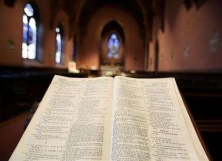
You don't have to be involved in a debate about some contentious issue, and what the Bible might say about it, for toolong before someone chimes up: "Sounds to me like you worship the Bible! Shouldn't Christians worship Jesus?"
The accusation is that, if you focus on what the Bible says, you are making the Bible your ultimate authority instead of making Jesus your ultimate authority.
There is a theological version of this argument and a practical version. The theological version is that it is Jesus, not the Bible, that is the 'Word of God' – most notably expressed (as we will remember this Christmas) in John 1, "The Word became flesh and lived among us" – but if we focus too much on the Bible, we are in danger of turning the Word made flesh back into a mere word again. Instead of incarnation we become guilty of decarnation, of turning God's word from something living and personal to something dry and propositional.
The more practical version observes what Jesus does with Scripture and what Scripture says about Jesus. On the one hand, Jesus appears quite happy to put the authority of his own words above the authority of the words of Scripture: "You have heard it said...but I say to you..." (Matthew 5:21–37). On the other, Jesus claims that the whole point of the Scriptures is to point to him: "You search the scriptures because you think that in them you have life. But it is these that testify about me" (John 5:39). In other words, if we get too obsessed with what the Scriptures say, it is like standing in front of a signpost studying it rather than following where it is pointing.
A recent blog post put it like this:
"Jesus is the thing. Scripture is the sign that points toward the thing. Scripture provides a series of portraits so that we will know the real thing when we see it. The difference between scripture and Christ is the difference between the menu and the food. The one describes the reality of the life-giving substance, the other is that life-giving substance."
It's worth pausing for a moment to consider these metaphors. If you are in a restaurant, you would be foolish to think that the menu could in any way nourish you. And yet the experience of Christians is that reading Scripture is indeed nourishing. And there's a good reason for that – Jesus himself compares what God says in Scripture to food. "People do not live on bread alone, but on every word that comes from the mouth of God" (Matthew 4:4) he says, citing the Old Testament scriptures as this word from God. Paradoxically, Jesus also describes himself as bread from heaven (John 6:35), but perhaps this is the key. When Jesus claims to be God's word, he is not displacing Scripture, but identifying with it. Jesus claims to be "the way, the truth and the life" (John 14:6) but he also claims that "the words I speak are spirit and life" (John 6:63). Jesus and his words offer the same thing.
Paul appears to support this identification. Scripture is "God-breathed", carried on God's breath by his Spirit to us (2 Timothy 3:16), just as anyone's words are carried by the outflow of their breath (try speaking while breathing in!) And yet it is precisely studying these Scriptures which can deliver the experience of salvation through Jesus, if you read them aright (2 Timothy 3:15). The writer to the Hebrews appears to contrast the way God has spoken in the past with the way God has spoken "in these last days" through Jesus (Hebrew 1:1–2). But this cannot be a contrast between what is written and what has been incarnated. The only way we know of Jesus, his ministry, his teaching and the meaning of his life and death is through the scriptures of the new covenant. These verses looks less like a rejection of the written word than a case for the extension of the written word to include the testimony to Jesus we find in the gospels.
Perhaps this gets us to the heart of the issue. When Jesus challenges the "Jewish leaders" (John 5:16) about the Scriptures which "point to me", he highlights for us that they have two things before them: the Scriptures themselves, and Jesus who stands before them. We are not in the same position, since we do not have the incarnated Word standing before us. Instead we have the testimony to Jesus in the gospels and letters. If we believe in a cosmic Christ, disconnected from history and accessible in some ethereal, mystical way only, then the contrast with the Scriptures is one we could make. But if we believe in the historical Jesus, if we believe that the Word really did become flesh, then it is focusing on these Scriptures that leads us to Jesus. That is precisely why John later makes this point:
"These are written that you may believe that Jesus is the Messiah, the Son of God, and that by believing you may have life in his name" (John 20:31).
Contrasting Scripture and Jesus is as odd as contrasting what someone says with the person themselves. It is an imperfect analogy, but it would be very strange for me to say, "I don't need to listen carefully to what my wife says –after all, I married her and not her words!" This kind of false dichotomy actually separates who God is from what God says, and if we divide God in this way we are heading for trouble – not least because the foundational belief of Scripture is that "God is one" (Deuteronomy 6:4).
As it turns out, this kind of division is a prelude to then saying the Scripture is wrong, that it is an unreliable guide to what God says, and doesn't in fact tell us the truth about God and Jesus. The question then follows: how do we know the truth? This then becomes a matter of private discernment by individuals, who can inform us in their wisdom which aspects of Scripture are reliable and which are misleading, rather than a matter of the shared discernment of God's people by reading the Scriptures together.
Now, there is sometimes a problem with Christians focusing on the propositional rather than the personal as they read. But the problem here is not to do with separating Scripture from Jesus, but with reading Scripture poorly. Scripture, understood as God's words to us, is less a manual for living than the act of communication of a loving father to his children, and we need to take is as such. It is given to us not just for information but for formation, to make us more like Jesus. But if we want God to make us more like Jesus by his Spirit, we need to focus more on what he has said in Scripture – not less.
Rev Dr Ian Paul is Honorary Assistant Professor at the University of Nottingham and Associate Minister at St Nic's, Nottingham. His award-winning blog is at www.psephizo.com