Did the Islamic State (ISIS) jihadist group have a hand in the downing of a Russian airliner in Egypt's Sinai Peninsula, killing all of 224 passengers aboard?
A chilling video uploaded by jihadists supposedly linked with the ISIS in Sinai purportedly showed the ill-fated Airbus A-321 jet being shot down, exploding and falling through mid-air.
An official of a Moscow-based aviation agency said on Sunday that the airliner broke up in mid-air, Reuters reported. The official who visiting the disaster site stressed, however, that it was too early to draw conclusions from this.
"The destruction happened in the air, and fragments were scattered over a large area of around 20 square kilometres," said Viktor Sorochenko, director of the Intergovernmental Aviation Committee.
Russia's Transport Minister Maxim Sokolov also said on Sunday that the cause of the crash of the Russian airplane in Egypt on Saturday is still unknown, Interfax news agency reported.
"One can't accurately answer the question about the causes of the crash, since there is little information accumulated," Sokolov said.
However, after the purported crash video was posted online, Terror Monitor, an online terrorist monitoring organisation, said it had received an unverified statement from ISIS militants claiming responsibility for the downing of the Russian airliner.
The statement supposedly stated that the aircraft was shot down "in response to Russian airstrikes that killed hundreds of Muslims on Syrian land," as quoted by Sunday Express.
However, BBC analysed the video of the supposed shooting down of the plane and concluded that what appeared in the video was not the official ISIS video, also noting that the material was not posted on official channels of the militants.
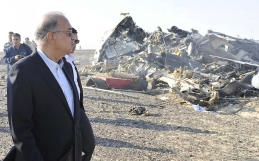
Egyptian Prime Minister Sharif Ismail also said in a BBC report that the Russian airliner could not be shot down by militants from the altitude it was flying at before the crash, which was estimated to be at 31,000 feet or 9,450 meters.
Egypt's minister of civil aviation Mohamed Hossam Kemal, meanwhile, said in a news conference that the pilot of the ill-fated plane did not send any distress signal before the aircraft crashed.
"The plane did not request a change of route," Kemal said, as quoted by Al Jazeera.
The Airbus A321-200, operated by the Moscow-based Metrojet airline, went down in a remote mountainous part of the Sinai Peninsula 23 minutes after the aircraft took off from Sharm el-Sheikh City on Saturday morning.
The plane was carrying mostly Russian tourists returning to St. Petersburg from holidays in the popular Red Sea resort.