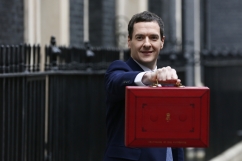
Chancellor George Osborne is running out of room to keep his centrepiece budget surplus plan on track without resorting to big tax increases or further deep spending cuts, economists said on Thursday.
Osborne delivered an annual budget statement on Wednesday that maintained his target of putting Britain's public finances back in the black by the end of the decade, despite a much weaker outlook for the economy.
His plans now look increasingly at the mercy of a further downturn in Britain's growth prospects, which have darkened significantly in just the last few months.
"If I were the chancellor, it would be keeping me awake at night," said Paul Johnson, director of the Institute for Fiscal Studies, a think tank that focuses on budget analysis.
Britain's Office for Budget Responsibility blamed weak productivity – the Achilles' heel of the – when it cut official growth forecasts to an average of 2.1 per cent a year for the rest of the decade, down from an estimate of 2.4 per cent it made as recently as November.
Johnson said there was a chance that estimate would be lowered again when the next budget update is due at the end of 2016.
"If there was another downgrade in fiscal forecasts of a similar magnitude and the Chancellor did wish to remain on course... then this would surely require more real policy change," he said.
Osborne has made the surplus target his overarching priority and used his reputation as a tough guardian of the public finances to help the Conservative Party win last year's national election. But as the economy has slowed, the odds on Osborne becoming Britain's next prime minister have lengthened.
On Wednesday, he said he would miss a separate fiscal goal this year and would be unable to keep public debt falling as a share of economic output.
In his efforts to remain on track with his surplus target, Osborne plans a much sharper squeeze on spending in 2019/20 than previous years as well as accounting manoeuvres such as changes to flows of corporation tax revenues.
Some economists say that puts Osborne's plans at odds with the image of prudence he aims to project.
"The point of a fiscal rule is to boost credibility. Meeting it only by the use of one-off accounting gimmicks entirely defeats the point," said Jonathan Portes, principal research fellow at the National Institute of Economic and Social Research think tank.
Simon Wells, an economist at HSBC, said Osborne's options looked limited if growth slowed further. "You end up with an increasingly implausible forecast that essentially ticks the box but kicks the pain out further into the future."