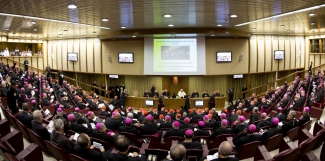
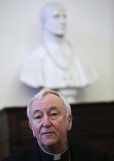
The Pope hit out at "traditionalists" yesterday after his attempt to make the Catholic Church less hostile to the homosexual community failed.
At the end of the two-week Extraordinary Synod on evangelising the family, it was also clear that Pope Francis will struggle to push through any reform on marriage and divorce at the open synod in Rome in October next year.
Without any softening of the Church's current position, clergy will be expected to teach that homosexuality is a tendency ordered towards an intrinsic moral evil. In the pews, they will also continue to have to turn away devout Catholics from receiving communion if they've had a civil marriage after a divorce, even when they were the innocent party in the divorce.
Some of the strongest opposition to offering a more welcoming stance to homosexuals came from bishops from the Global South. Homosexuality is illegal in 37 African countries and merits the death sentence in Mauritania, Sudan and northern Nigeria.
Although they have simmered under the surface for years, in laying bare the depth of divisions in the Catholic Church for the first time, Pope Francis' extraordinary synod has shown the Anglican Communion that it is not alone in its own struggles in these areas. Even though the Pope's mission for reform did not meet with the success he hoped, the strong support he got was greater than many expected, given the centuries of tradition and the face that most of the cardinals were appointed by his predecessor, the conservative Pope Benedict, who as Cardinal Ratzinger authored the "intrinsic moral evil" text on homosexuals.
Concluding the synod at the Holy See, Pope Francis said there had been many "consolations" but also "moments of desolation, of tensions and temptations".
These included the "temptation to hostile inflexibility", or following the "letter" of the law, rather than being guided by its "spirit". In an apparent reference to the Bible passage where Jesus condemns the "pharisees" of his time, the Pope said: "From the time of Christ, it is the temptation of the zealous, of the scrupulous, of the solicitous and of the so-called – today – 'traditionalists' and also of the intellectuals."
He also warned however against a "deceptive mercy" that treats the symptoms and not the causes and is the temptation of the "do-gooders", of the fearful, and also of the so-called "progressives and liberals."
The Church must not "bow down to a worldly spirit", he said, or fall into Byzantine language designed to smooth things over by saying nothing.
Elena Curti, writing for The Tablet in Rome, described the outcome as a "setback" for the Pope and others pushing for a more pastoral approach towards those in "irregular unions".
Referring to the final document, the Relatio Synodi, she said: "Three paragraphs relating to gays and to offering Communion for divorced and remarried couples – much more anodyne than in the splendid mid-term relation – did not achieve the requisite two-thirds majority. This shows to the world that the Catholic Church still has a long way to go if it is going to address the yawning gap between its moral teaching and how most people – including Catholics – live their lives."
At the Pope's insistence the final document was published in full and included the three paragraphs that had failed to receive the two-thirds majority as well as the voting figures.
Curti wrote: "It was revealed last night that the small working groups that met in the second week of the synod proposed a total of 470 amendments to the mid-term relatio.
"Reading through the reports of the three English-language groups I was struck, above all, by their timidity. They were fearful that in reaching out so generously to divorced and remarried, to gay couples, cohabiting heterosexual couples and those in civil unions, the message about the importance and beauty of marriage would be lost. They wanted to affirm more fully those married couples who struggled on, sometimes in the face of enormous difficulties. One group even opined that seeing grace and goodness in so called irregular unions (horrible phrase) would 'confuse the faithful'.
"The faithful are not confused. Rather, many Catholics who stay married are worried that so many fellow Catholics – especially their children – perceive the Church's teaching in this area as irrelevant."
A recent Tablet survey showed that a third of remarried Catholics continue to receive Communion with or without consulting their priest, and figures from the Canon Law Society show a decline in the number of Catholics seeking annulments.