Mercury, the solar system's innermost planet, may just look plain gray, dull and boring for ordinary stargazers like us on Earth, but recent photos released by the National Aeronautics and Space Administration (NASA) showed the planet closest to the sun in its full technicolour.
The space agency recently generated new images of Mercury using the so-called Mercury Atmosphere and Surface Composition Spectrometer (MASCS), located aboard NASA's Messenger spacecraft.
The colourful images were particularly made through the MASCS' portion called the Visual and Infrared Spectrometer (VIRS), which allows space scientists to study Mercury's surface and exosphere.
The early images released by NASA showed a psychedelic Mercury, looking like a deep iridescent blue ball with patches of sandy brown, and occasional strands of electric blue.
What do these different colours stand for? For NASA, these represent the composition of the innermost planet.
The darker portions of Mercury, for instance, show the areas of the planet that have long been exposed to harsh conditions. The blue parts, meanwhile, indicate Mercury's younger portions. The intermediate terrain on the planet is meanwhile shown by the yellowish or tan-coloured regions.
Significant portions of Mercury can also be seen in the colourful photos released by NASA. For instance, the Caloris basin is shown in the photo as the prominent roughly circular patch brightly coloured sandy brown at the upper right hand side of the image. The Caloris basin is an impact crater believed to have been formed when an asteroid landed on Mercury's surface during the solar system's early days.
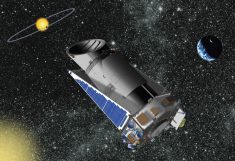
NASA's messenger spacecraft has been collecting data about Mercury since it was launched in 2004, considered to be a first in the history of planetary exploration. This spacecraft is special because it is able to function even in temperatures higher than 600 degrees Fahrenheit.