
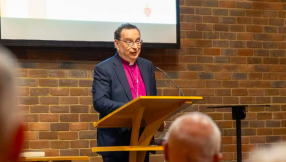
The Archbishop of York has voiced concern that the safety of patients may be put at risk by changes to the way the NHS is run.
Dr John Sentamu’s warning comes just days before peers are due to vote on the Government’s controversial Health and Social Care Bill.
The Bill outlines plans to give more responsibility for spending the budget to GPs and clinicians, while opening up more of the care provision to private providers.
The Government argues that competition between hospitals would improve quality in the NHS and that the changes would give patients greater choice over the treatment they receive.
Critics argue, however, that the reforms will lead to a privatisation of the NHS and limit the number of services available, discriminating against the poor and the elderly in particular.
Dr Sentamu, who recently had emergency surgery to remove his appendix at an NHS hospital, questioned the proposals.
He said: "We must never allow health provision in this country to become exclusive. Decent health care should not solely be the preserve of those that can afford to purchase it. I am certainly not persuaded by internal competitive markets when one is treating very ill patients."
He said there was a need for a national debate on healthcare provision within the NHS.
“We need to recognise that there are no easy answers when we look at the demands on the NHS.
“Whilst we may strive to deliver value for money, we cannot allow care to be market-led or commercialised to the point where patient safety is put at risk. You cannot compare an NHS hospital to a supermarket.
“If we accept that healthcare can only touch some of the factors contributing to the overall health of a person, we need to challenge policy-makers over those aspects of funding and social policy that affect those who are suffering or living under the burden of societal injustice.”
The Archbishop said it was necessary to listen to doctors, not just patients, as he warned against the impact of excessive bureaucracy on healthcare provision.
“Doctors took up the vocation to treat patients and not to be managers of budgets or fund-holders. Let us not do to doctors what we have done to teachers: made them managers of budgets with targets to meet.”
He continued: “The problem with targets are that they are not based on need, they are based on numbers. I spent two weeks in St Thomas’s Hospital.
“What was the target for treating someone with a very acute condition which came on suddenly? What was the permissible budget?
“It is not just the patients who suffer because of this behaviour. We should not underestimate the impact of bureaucracy on the morale of those working in the health system.”
The Bill is due to come before peers on Wednesday.
-

The dire American political situation: a brief overview for faithful Christians in Britain
-
Police appeal for witnesses after head smashed off Jesus statue at church war memorial
-

Many churches lack AI policies despite widespread support among pastors, study finds
-

Poll shows support for conversion therapy ban disappears once people learn its implications
News
-

Former Crowded House pastor and wife charged with rape
-

Enoch Burke accuses Archbishop of remaining 'silent' in school trans dispute
-
'Such a blessing' - church that closed down 15 years ago opens its doors again
-

Half of Christian questions on ChatGPT are attempts to understand the Bible
-
Archaeologists may have discovered identity of mystery skeleton in Westminster Abbey
-
Christians urged to speak out against 'conversion practices' bill
Most Popular
News

Questions raised about demolition of 19th century church in Manchester
Save Britain's Heritage has questioned the process behind the decision to call in the bulldozers.
Bishop raises plight of Christians caught in Sudanese civil war
Sudan has been in a state of civil war for most of its post-independence history.

Are we seeing the end of Western civilisation?
the riots now sweeping across Europe like some foul contagion demonstrate that Western culture is under attack, and that the enemy is within.
Church of Scotland nominates first prison chaplain as Moderator of General Assembly
For the first time in its 466-year history, the Church of Scotland has nominated a prison chaplain to serve as Moderator of its General Assembly.





