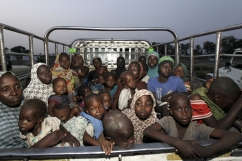
Since Nigeria's army began clearing large areas of the country's northeast from Boko Haram, some of the 1.5 million internally displaced people have started returning home. But thousands could now face severe food shortages as reconstruction lags behind.
Along the main roads heading north from Adamawa's state capital Yola, some trade has resumed in the towns but ghostly pockets and haunting reminders of the insurgent takeover are evident. Some three months after the fighting ended, the smell of rotting corpses still clings to the air by the headquarters of the Church of the Brethren near Mararaba.
Islamist militant group Boko Haram grabbed swathes of Nigeria's northeast last year, killing thousands in an unprecedented land grab. It took over most of Borno state, the birthplace of the group, and parts of Adamawa and Yobe while increasing incursions on neighboring countries.
The army began pushing back when Boko Haram was about 100 km (60 miles) from Adamawa's state capital. In the last few months, many people have returned to Adamawa but health clinics, banks and schools are still lacking, especially in the northernmost areas, and vast stretches of farmland between towns stand barren.
In the town of Michika, which saw some of the fiercest fighting, residents are too afraid and lack the equipment and manpower to farm, and at least for the moment they will not be able to live off the land.
Meanwhile there is no sign of government aid.
"Most people coming back are in hardship because there's no food. People are sick but there are no hospitals ... no vegetables, no lemons, no bananas ... We're not ready to go back to farming. All our machinery was burned or taken," a Christian community leader, Sini T-Kwagga, told Reuters.
People will drive to Mubi, a city about an hour's drive south, to get goods but this vital route will be blocked once the rainy season comes into full swing next month.
Many bridges were blown up by Boko Haram, including the important link to Mubi, to try to stop the offensive by Nigerian troops. The river is already starting to fill up with early rains and men have to push cars through the muddy waters while women sell mangoes to passers-by.
Madagali, the northernmost major town in the state and the last to be liberated in Adamawa in February, also depends on this route.
Mubi itself was a Boko Haram stronghold at one point. Life is bustling again but its banks are still closed and in ruin.
LANDMINE DANGER
Rusting tanks with Arabic writing, burnt cars and military equipment litter the main roads in northern Adamawa. Boko Haram writings cover the beige outdoor walls of buildings, roofs are collapsed and gutted churches stand charred.
Some landmines are still dotted around Michika and the main farming areas are far away from military checkpoints.
"We have to stay, we have nowhere to live, no money for rent. We are afraid to farm ... about a week ago a bomb exploded when people went to clear the land. They were hurt," Rebecca Ishaya said.
She came back two weeks ago with her children but sent a few away again because of the lack of schools.
Boko Haram militants liberally employed landmines, often handmade in their bomb factories, to protect their strongholds. The military said this strategy was slowing their offensive into the Sambisa forest reserve, which is the militants' last bastion and where hundreds of abducted women and children have been found.