
Ten years ago, we entered the new millennium with high hopes. World leaders, on our behalf and with our blessing, agreed that we would be the generation that changes the world – forever.
A set of promises were made which aimed to tackle global poverty, save lives and put behind us once and for all some of the world’s biggest injustices.
They were called the Millennium Development Goals (MDGs).
Through the United Nations, governments around the world signed up to halving poverty by 2015, and outlined eight commitments that would bring us to that point:
1 Eradicate extreme poverty and hunger
2 Achieve universal primary education
3 Promote gender equality and empower women
4 Reduce child mortality rate
5 Improve maternal health
6 Combat HIV/AIDS, malaria and other diseases
7 Ensure environmental sustainability
8 Develop a global partnership for development
Ten years in, UN Secretary-General Ban Ki-moon called heads of state together to discuss how to accelerate progress towards achieving the MDGs.
I was there too, as were hundreds of people from agencies on the frontline of tackling poverty and speaking up for justice. At Tearfund, we believe strongly in tackling the structural causes of poverty as well as dealing with its effects, and events like this give us the opportunity to speak up with and for the poorest people in the world.
We met with Government ministers, from the UK and other parts of the world, to try to draw out further commitments on sanitation, for example, because a lack of basic sanitation causes children to die of preventable diseases every single day and dramatically affects child and maternal health.
We asked for replenishment of the Global Fund, which tackles HIV, TB and malaria.
We called for a clear roadmap for the next five years, showing how we will together achieve the MDGs and giving clear measurable targets so we can hold governments to account.
We highlighted the role of the church in being part of the solution to poverty, based as it is in the heart of its community and uniquely placed to facilitate conversations and decisions that are led by local people and will bring about sustainable change.
And we pointed out that climate change is often the ‘elephant in the room’ when discussing global poverty. The world’s climates are already changing, and the impacts of changing seasons and natural disasters disproportionately affect people living in poor communities who do not have the infrastructure to prepare themselves for disasters or to respond to them.
So, we spent the week – as we have spent many months and years doing so up to this point – calling for change on these vital issues.
We were disappointed.
We heard some positive words. We saw some small-scale commitments at a country level to the Global Fund and to a financial transaction tax.
We saw a very high-profile launch of Every Woman Every Child, which is the new global strategy for women’s and children’s health, and which brought together governments, civil society, business and philanthropists.
But it wasn’t enough. We don’t know what the next five years will look like, and nothing happened this week to bring us closer to this vision.
And that’s a disappointment. It’s a disappointment for people like me, who spend our lives calling for justice, and it’s a disappointment to the billion people who go to bed hungry every night.
That’s why we’re not going to stop. We’re not going to stop responding to emergencies, like the natural disasters in Haiti and Pakistan this year or the conflict-related emergencies like the situation in Democratic Republic of Congo (DRC). We’re not going to stop supporting the church to be the agent of change in its community, reaching out to people in need and seeing people released from material and spiritual poverty.
And we’re not going to stop speaking up for justice, to governments and decision-makers in the UK and around the world.
We owe it to the billions of people who, with us, were disappointed this week.
Tearfund is a Christian relief and development agency building a global network of churches to help eradicate poverty.
www.tearfund.org
-

Churches must do more to equip Christians for evangelism, says J John
-

John Lennox urges Christians to overcome fear of sharing their faith
-

US Episcopal Church membership falls below 1.5 million as decades-long decline continues
-

Young people are finding their way to the Christian faith through media, says bishop
News
-
Nicky Gumbel elected to Church of England parliament with a call to put evangelism first
-

Pastor died after wooden arch fell at Big Church Festival, inquest hears
-

John Lennox urges Christians to overcome fear of sharing their faith
-
Priest dies after cross falls on him during livestreamed Mass
-

Are we ready to battle for the Gospel?
-

Church warden and rector lead legal challenge against Church of England's Project Spire
Most Popular
News
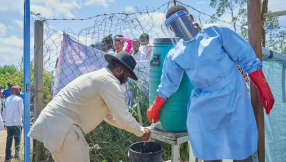
Ebola death toll mounts as outbreak spreads further across DR Congo
Healthcare workers are struggling to contain the disease amid shortages of essential medical equipment and ongoing insecurity.

Research suggests married mothers are happier
New research has suggested that married mothers report significantly higher levels of happiness than those who are single or unmarried.
US Episcopal Church membership falls below 1.5 million as decades-long decline continues
The US Episcopal Church has reported a further decline in membership and worship attendance, with new data it has fallen below 1.5 million members despite signs of post-pandemic stabilisation.
Priest dies after cross falls on him during livestreamed Mass
A priest in Guayaquil, Ecuador, has died after a crucifix fell on him during an evening Mass on Saturday.








