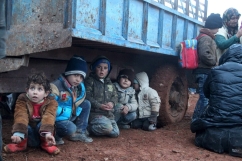
The flow of refugees through the Balkans and towards Germany will be slowed progressively as part of a coordinated "domino effect" of restrictions by countries along the route, Austria's interior minister said in comments published on Tuesday.
Austria has largely served as a corridor into neighbouring Germany for the hundreds of thousands of people, many of them Syrian refugees, who have streamed onto its territory since the two countries opened their borders to them in September.
It has, however, taken in a similar number of asylum seekers to Germany in proportion to its far smaller population, and the coalition government has said it will not be able to cope if the influx continues unabated.
With European measures to address the continent's migration crisis facing mounting delays and public support for the far right having risen, Vienna is turning to a "Plan B" aimed at stemming the flow of people without going through Brussels.
It has already said it will limit asylum applications to less than half last year's total, and last week Foreign Minister Sebastian Kurz told Macedonia to be ready to "completely stop" the flow of migrants across its southern border, adding that Austria would soon do the same.
"The domino effect along the Balkan route is developing according to plan," Interior Minister Johanna Mikl-Leitner, who is expected to announce new border measures later on Tuesday, was quoted as saying by Austrian newspaper Kurier.
"It is important that each country progressively restrict the flow on its border, and that we do that in agreement with each other," she said, adding: "The brakes are being applied step by step."
Macedonia, lying near the bottom of the Balkans next to Greece, has erected two lines of metal fencing topped with razor wire along its border at the main crossing point for refugees.
Austria has erected barriers and a roughly 4-km (2.5-mile) fence as crowd-control measures at its main crossing for migrants, at Spielfeld on its southern border with Slovenia.
Kurier said the country was preparing to introduce a similar crowd-control system further west at the Karawankentunnel crossing, also on the border with Slovenia.
The introduction of such barriers was also possible at the Brenner crossing with Italy, a vital transport link, the paper said, adding that border supervision might be stepped up at nine other crossings on the Italian, Slovenian and Hungarian borders.