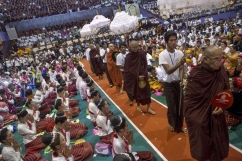
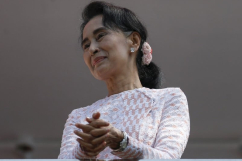
Myanmar's Aung San Suu Kyi was set to address on Tuesday hundreds of representatives of ethnic armed groups, the military and lawmakers, gathered for talks over a ceasefire to end insurgencies that have plagued the country for decades.
The Nobel peace prize laureate's National League for Democracy (NLD) won an historic election victory in November, but her party will not take power until March, with a presidential election expected to take place a month earlier.
The outgoing semi-civilian government of President Thein Sein signed a ceasefire in October, but seven of 15 armed groups invited to participate declined to sign, including some of the most powerful.
Suu Kyi had snubbed the government-led peace process, and the latest talks in the capital Naypyitaw are expected to yield little in the way of concrete deals, but could lay the groundwork for negotiations once the NLD takes power.
The armed groups, who have been fighting for greater rights and autonomy, are hoping that Suu Kyi's international standing and mandate would help her succeed in bridging areas of disagreement with the country's powerful military.
"We have high expectations for Aung San Suu Kyi and her government to negotiate with army chief – without the military's involvement it will be impossible to end the fighting across the country," said Padoh Saw Thamein Tun, one of the leaders of the Karen National Union, an ethnic armed organization.
Since the October signing, fighting has flared in eastern parts of the country between the military, non-signatories and groups that did not take part in the negotiations.
The gathering in Naypyitaw will also be attended by President Thein Sein and the powerful army chief Min Aung Hlaing, and their appearance along with Suu Kyi reflected how smoothly the transfer of power has gone so far.
Myanmar's generals ran the country for 49 years, until 2011, when a hybrid civilian-military government was installed.
Suu Kyi remains barred from becoming president under the military-drafted constitution, and the military remains a powerful political force.
A quarter of seats in parliament are reserved for unelected military officials. Three important cabinet ministers – home affairs, defence and border affairs – are also chosen by the commander-in-chief.