President Bashar al-Assad said it would not be difficult to agree on a new Syrian government including opposition figures, but his opponents responded on Wednesday that no administration would be legitimate while he remained in office.
Assad, bolstered by military victory in the desert city of Palmyra, was quoted by Russia's RIA news agency as saying a new draft constitution could be ready in weeks and a government that included opposition, independents and loyalists could be agreed.
While the distribution of portfolios and other technical issues would need to be discussed at Geneva peace talks, which resume next month, "these are not difficult questions", Assad said.
Opposition negotiators immediately dismissed Assad's remarks, saying that a political settlement could be reached only by establishing a transitional body with full powers, not another government under Assad.
"What Bashar al-Assad is talking about has no relation to the political process," said George Sabra of the High Negotiations Committee.
The United States also rejected Assad's comments. "I don't know whether he envisioned himself being a part of that national unity government. Obviously that would be a nonstarter for us," White House spokesman Josh Earnest said.
Syria's crisis erupted five years ago with protests against Assad which were put down with force. It descended into a civil war which has killed more than 250,000, drawn in global military powers and helped Islamic State establish its self-declared caliphate. Nearly five million refugees have been driven abroad.
At a conference in Geneva, UN Secretary-General Ban Ki-moon called on countries to resettle nearly half a million Syrian refugees in the next three years.
"This demands an exponential increase in global solidarity," he said, though his appeal won immediate responses from only three countries - Italy, Sweden and the United States.
Assad told RIA the war had cost more than $200 billion in economic losses and damage to infrastructure. That is in line with a UN-backed body which estimates physical damage at $90 billion, with an additional $169 billion of accumulated losses from a collapse in GDP to less than half the 2011 level.
Despite Assad's upbeat assessment of the chances for a political solution, his comments reflected deep differences with the opposition. It says that for the last four years international agreements on Syria's future have centered on the principle of setting up a transitional governing body.
Assad's opponents have understood that such a body would have full powers, and that he would not play a further role.
But the president said the very idea of a transitional body was "illogical and unconstitutional".
"That's why the solution is forming a national unity government which prepares for a new constitution," he said, adding that its formation would be agreed in Geneva.
Looking to Raqqa
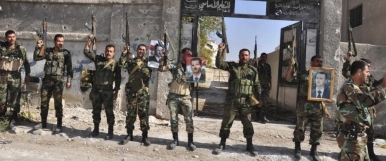
Russia's six-month-old intervention in Syria helped to swing military momentum in Assad's favor, reversing last summer's gains by insurgents including Western-backed rebels and helping government forces to drive Islamic State out of Palmyra on Sunday.
The recapture of the Palmyra and its military airport, in the central Syrian desert, opens up the road further east to the Islamic State bastions of Deir al-Zor province and Raqqa.
"After liberating Palmyra it is necessary to move into the nearby regions which lead to the eastern parts of the country, for example, Deir al-Zor," Assad said. "At same time, we need to start in the direction of Raqqa, which is currently the main Islamic State stronghold."
Any offensive on Deir al-Zor or Raqqa however would probably need significantly more firepower than the Palmyra assault.
"It's an open question whether or not the Syrian army is going to be able to push any further to the east," said US Army Col Steve Warren, Baghdad-based spokesman for the US-led coalition against Islamic State. "They are stretched fairly thin and they still have a significant number of forces tied up in Palmyra."
Although the United States and Russia worked together to establish a limited UN-backed truce in Syria, which excludes Islamic State and al Qaeda's Nusra Front, US military officials have said they are not cooperating with Russian or Syrian forces.
The Russian-backed Syrian ground forces are concentrated in western parts of the country, confronting Islamic State on its western front. US-backed efforts in Syria, including Washington's support for a joint Kurdish-Arab force against the jihadi group, are focused instead on its northeastern flank.
However, Interfax news agency quoted Russian Deputy Foreign Minister Oleg Syromolotov as saying Moscow and Washington were discussing "concrete" military coordination to recapture Raqqa from Islamic State.
In a message to the UN's Ban, Assad said Syria was ready to cooperate with "all sincere efforts" to combat terrorism, state news agency SANA said. "This moment might be the most appropriate to accelerate the collective war against terrorism," it quoted him as saying.
Since capturing Palmyra, Syrian government forces and their allies have been targeted two towns to the east and west of the city, seeking to eliminate Islamic State from an expanse of desert in the center of the country.
Backed by Russian air power they virtually surrounded the town of al-Qaryatain, state media have reported. Heavy air strikes have also struck near the town of Sukhna, where Islamic State fighters retreated to when they pulled out of Palmyra.
Russian and Syrian officials say the retreating jihadis left mines and explosives among the 2,000-year-old ruins which they abandoned in Palmyra, and Assad appealed to the UN to help restore the ancient monuments.
Islamic State fighters dynamited two Roman temples, a triumphal arch and funeral towers last year, and also smashed statues and displays at the city museum before they fled.
Russia said earlier it was sending military engineers, sniffer dogs and "demining robots" to help defuse explosives in the old city.