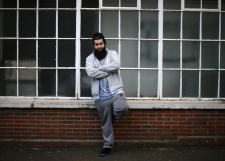
A quiet student at Kabul University, 25-year-old Abdul Rahimhas a dream: to join Islamic State in Syria and fight for the establishment of a global caliphate - a new, alarming form of radicalism in war-weary Afghanistan.
"When hundreds of foreigners, both men and women, leave their comfortable lives and embrace Daish, then why not us?" he asked, using a word for Islamic State common in the region.
Although IS is not believed to have operations in Afghanistan, its influence is growing in a country already mired in daily bombings and attacks by Taliban insurgents.
With most foreign combat troops leaving the country by the end of the year, there is growing uncertainty over what direction Afghanistan will take, with the emergence of IS ideology adding a new risk.
A few dozen students have set up an underground group a few months after IS started making inroads into Central and South Asia this year.
Several hardline insurgent groups in tribal areas between Afghanistan and Pakistan have pledged allegiance to IS, propaganda leaflets have been distributed and some local commanders are said to have met IS members.
But the formation of the clandestine student group is the clearest indication yet that IS ideas are taking hold more broadly.
"Several students who are close to us went to Syria to join our brothers for a holy cause," said student Gul Rahman, holding a mobile phone with IS's black flag logo on the screen.
Islamic State is a violent Sunni group which controls large areas of Iraq and Syria. It announced the establishment of a caliphate in June.
IS also announced intentions to bring Afghanistan, Pakistan and India under its control, although so far only eight Afghan citizens have travelled from Afghanistan to fight in Syria, security sources told Reuters.
The number is tiny compared with the thousands of recruits who have left European countries to join, with IS's influence in South Asia still embryonic.
TALIBAN COMPROMISED?
The students, speaking at a tea-shop away from campus and fearing arrest if they are identified, said they drew inspiration from IS's success in the Middle East and saw it as the best chance of bringing Asia under Islamist rule.
They were willing to give their names because they were so common the authorities could not identify them, they added.
Kabul University has long been a cauldron of radical views - both under the Soviet occupation when students sided with the rebels and later when the hardline Taliban took control of the country in the 1990s.
Now IS ideology appears to be spreading, although there is no evidence yet the trend goes beyond gatherings where students discuss ideas. None of the young men who agreed to be interviewed were armed, nor appeared bent on launching attacks in Afghanistan.
Rahman and Gul said they want to fight in Syria and Iraq because IS does not yet have enough of a presence in Afghanistan to challenge national and foreign armed forces.
They have also abandoned support for the Taliban, saying it strayed from religious doctrine in the pursuit of power.
"The Taliban are more of a political movement but Daish (IS) is purely Islamic," said Rahim, sporting a bushy beard and shaved moustache.
They said the Taliban had little chance of regaining power and was more closely aligned with Pakistan's national interests than their religious ideals.
Despite its radical associations, Kabul University's leafy campus is a place where male and female students freely mingle, along with conservative scholars of religion. President Ashraf Ghani was a former dean.
"TIME BOMB"
The Afghan intelligence agency, the National Directorate of Security (NDS), denied the existence of "systematic and organized networks" among Kabul students, but admitted IS was trying to build support.
"Anyone related to this group (IS) will be apprehended," said Hasib Sediqqi, a spokesman for NDS.
Afghan officials are concerned that IS, a fiercely anti-Shia group, could incite sectarian violence which has been largely avoided in recent years.
Rahman is from Kunar, a mountainous province in the east of Afghanistan that shares a porous border with the tribal areas of Pakistan that serve as a base for the Taliban and al Qaeda.
He said several dozen students backed IS. Afghan authorities put the number of IS student supporters between 40 and 50.
The students use grisly posts on Facebook to recruit in the major cities that have internet, and their pages have hundreds of followers. Security officials say 14 students with ties to IS have been arrested, including a woman who ran a Facebook page.
Some professors voiced concern at radicalism on campus, where a strong anti-Western strain is prevalent among students, most of them from rural areas that have borne the brunt of the US-led war.
"They radicalize other students, they are against co-education and incite others against foreigners and the Afghan government," said one professor, who asked not to be named.
"If we do not take care of this time bomb, it will cause damage beyond our control."