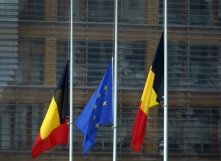
In the aftermath of a major terrorist attack there is now a well-rehearsed routine. There are rumours of other attacks and false alarms, shock is expressed, articles are penned about how we all should have seen it coming, social media profile pictures are superimposed with flags and we read moving and tragic stories of heroism amid the slaughter.
As surely as day follows night, there is another response which comes after an attack. Leading politicians from around the world will publicly state their re-doubled intention to "destroy this evil." Newspapers, opinion formers and community leaders won't be far behind. The outcry following yesterday's horrific attacks on the airport and metro system in Brussels in which at least 34 people died has followed this familiar pattern.
"Fighting this evil calls for the most active international cooperation," said Russian President Vladimir Putin. "Strike at evil's heart or cancer will grow," shouted an Australian newspaper headline. A leading European rabbi said, "Evil can and will be destroyed only by recognising it, and fighting it."
The American presidential candidates weighed in and stayed on similar territory. Republican Ted Cruz said, "We can never hope to defeat this evil so long as we refuse to even name it." Rival John Kasich tweeted, "We must strengthen our alliances to root out evil."
In response to similarly heinous crimes over the last 15 years we have heard the same sentiments. In the wake of last year's attacks on Paris, British Prime Minister David Cameron declared that, "We have shown our firm resolve and together we will destroy this evil threat." French President François Hollande said at the time, "My first duty is to protect the French people... That means attacking the root of the evil."
This idea of destroying evil is shared by politicians on the left and the right. President Obama, while detailing actions against ISIS said, "There can be no reasoning – no negotiation – with this brand of evil. The only language understood by killers like this is the language of force." His predecessor, George W Bush, in the aftermath of 9/11, declared that, "My administration has a job to do and we're going to do it. We will rid the world of the evil-doers." Bush's comrade-in-arms, Tony Blair, said in the aftermath of the devastating 7/7 attacks on London that he was determined to "uproot this ideology of evil."
I could go on. This contemporary trope of 'uprooting,' or 'destroying' evil is now entrenched in almost every response a major leader makes to a terrorist atrocity. We need to stop and ask ourselves where that leaves us.
The first question to ask is, has it worked? When Bush said he would "rid the world of the evil-doers" was it just a turn of phrase, inserted by speechwriters to make him look like a tough war-time leader? Or was he so high on his own hubris that he genuinely believed this claim?
How could a president believe such a thing? Even if every last Islamist terrorist was captured or killed, that would make no dent on the evil perpetrated by regimes as diverse as North Korea, Zimbabwe, or our 'friends' in Saudi Arabia.
The chutzpah of neo-conservative Western leaders in claiming they were going to root out evil has been shown to be nothing more than a farce. Look at Iraq and Syria – they are in flames. Thirteen years after Bush and Blair's mission to rid Iraq of its evil dictator Saddam Hussein, the reign of terror propagated by his old ideological ally Bashar al-Assad and the death cult of ISIS shows no sign of abating.
Has evil been rooted out? No, of course it hasn't. The pronouncements of Western military leaders have been shown up – the Hydra was beheaded and now we face a far more potent form of the evil they claimed to want to destroy.
That very few in public life seem to have noticed this abject failure of the bid to destroy evil is unsurprising, given how theologically, philosophically and morally uninquisitive so many of our leaders seem to be. In an excoriating essay on evil, the iconoclastic philosopher John Gray recognises this problem. "Whatever their position on the political spectrum, almost all of those who govern us hold to some version of the melioristic liberalism that is the West's default creed, which teaches that human civilisation is advancing – however falteringly – to a point at which the worst forms of human destructiveness can be left behind" says Gray. "According to this view, evil, if any such thing exists, is not an inbuilt human flaw, but a product of defective social institutions, which can over time be permanently improved."
Gray asserts that all our leaders are 'progressives' in the widest sense. They believe that the human condition is improving, that life is generally getting better and, most fundamentally, that evil can be destroyed by human effort.
This is utterly alien to a Christian worldview. The doctrine of original sin shows us how flawed we all are. More than that, though, it shows how foolhardy it is to imagine we can 'destroy evil.' Christian faith urges us to recognise the deep problem in our own hearts and lives and not to "conform to the pattern of this world, but be transformed by the renewing of your mind." Would the world be better if ISIS was finished? Of course. But to suggest that the evil it represents can be 'destroyed' by military means is wishful thinking.
When the Allies defeated the Nazis – surely the ultimate personification of evil – that didn't mean evil had been destroyed. It meant a setback for evil and a victory for good, but evil has recurred in major global events in every generation since.
In this Holy Week, when our hearts break for the people of Brussels and the devastation caused to so many lives, we need to look again at Jesus. His answer to the evil he saw (and make no mistake, the Brussels attacks were acts of pure evil) was not to destroy that evil militarily. That was what his zealous disciples wanted more than anything, but Jesus didn't oblige them.
Instead he offered a different way. He faced the evil which surrounded Him, in the knowledge that victory would be won.
This doesn't mean that we shouldn't keep ourselves safe, militarily, here in the West. It doesn't mean that we shouldn't find and put on trial those responsible for the Brussels attacks. It doesn't mean there aren't significant questions about how to keep our major cities safe. These are all essential measures.
But let's forget the hubristic proclamations that we're going to 'destroy evil.' It's an impossible task which would require a fundamental re-engineering of the human condition. Our role is to build societies, institutions and relationships that make outbreaks of evil less common, less effective and less attractive. The rest, we leave up to God.