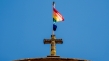
Once an officially godless state, Russia is now seeing the Orthodox Church—one of three main branches of Christianity, the other two being the Catholic and Protestant churches—expanding its influence, with the blessing of no less than President Vladimir Putin.
The moral authority of the Orthodox Church has grown steadily under Putin, who supports the church in promoting traditional family values and opposing homosexual rights, the Associated Press reported.
According to analysts, Putin seeks the Church as an ally to bolster nationalism with faith. They say the strategy has two main objectives—to fill the ideological void left by the 1991 collapse of the Soviet Union and to block the influence of Western liberalism.
"Since people who are now in power take their roots in the Soviet past, they're trying to find an equivalent of that ideology so that they can use it to manipulate the public, explain their policies by this ideology," said Boris Falikov, professor of religious studies at the Russian State University for the Humanities.
Christianity is seeing remarkable growth in Russia. A 2013 poll found that nearly 70 percent of Russians identify themselves as members of the church, a 14-point rise from the early days of Putin's rise to power.
The Russian government has acted on many occasions to defend Church's interest. In 2012, three members of the feminist punk band Pussy Riot were convicted of "hooliganism motivated by religious hatred" after they staged a protest concert inside Moscow's Cathedral of Christ the Savior.
The following year, Putin signed two bills making so-called "gay propaganda" and actions that "insult religious feelings" both crimes. A crackdown on gay rights protests followed.
Last October, authorities in the Siberian city of Omsk prevented the staging of the 1970 rock opera "Jesus Christ Superstar" after Christian protesters contended that the musical represented "an endless blasphemy and mockery of sacred notions."
Just last month, Orthodox activists launched a campaign to ban "Matilda," a Russian-produced movie scheduled for release in 2017 that is critical of Russia's last tsar, Nicholas II, who was canonised as an Orthodox saint in 2000. A Russian lawmaker promptly labelled the movie "a threat to national security."
When Putin hosted celebrities in St. Petersburg on Dec. 2, one of the film's stars challenged him to defend creative freedom.
Putin replied that organisers of public events must bear a share of blame if their work provokes violence.