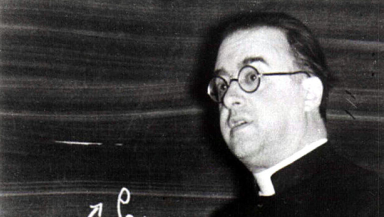
The scientific hypothesis known as the Big Bang Theory has stoked controversy among some in the Church, but it's often forgotten that the idea was conceived by a Christian priest.
Born in 1894, Monsignor George Lemaitre was a Belgian, Catholic cosmologist. At a young age Lemaitre showed promise as a mathematician, earning a PhD in the field, but instead of seeking an academic career instead turned to the priesthood.
However, he still relished his science as a priest and would soon return to it: working in astronomy, earning a PhD in physics and becoming a professor of mathematics.
Lemaitre understood science, like his love of philosophy and theology, as part of the search for truth. As he put it: 'Man's highest activity is searching for the truth.'
In 1927 Lemaitre published a paper positing, controversially, that the universe was expanding – what scientists now accept and know as Hubble's Law. In 1930 he suggested that the universe has been expanding from one particular point, a 'primeval atom' from which everything began.
One sceptical scientist, Fred Hoyle, rubbished Lemaitre's idea as 'The Big Bang Theory'. Even Lemaitre's friend and contemporary Albert Einstein had trouble accepting Lemaitre's radical suggestion that the universe was not static.
In time, though, the priest's hypothesis gained traction, Hoyle's nickname stuck, and it is now widely accepted and taught in the scientific community. Lemaitre didn't see science and religion as being at odds, but was wary of confusing them. If accused of contradicting the book of Genesis, he insisted that the Bible was not given to be read as a science textbook.
Lemaitre's legacy was celebrated in May at the Vatican with a cosmology conference uniting the Church and science, seeking to better understand the mysteries of the universe.
Lemaitre died as one of the world's most renowned scientists on this day in 1966.
In his work on the primeval atom, he wrote: 'We cannot end this rapid review which we have made together of the most magnificent subject that the human mind may be tempted to explore without being proud of these splendid endeavors of Science in the conquest of the Earth, and also without expressing our gratitude to One who has said: "I am the Truth," One who gave us the mind to understand him and to recognize a glimpse of his glory in our universe which he has so wonderfully adjusted to the mental power with which he has endowed us.'