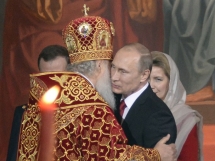
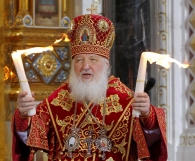
The head of the Roman Catholic Church and the head of the Russian Orthodox Church are to meet for the first time in nearly 1,000 years tomorrow.
Pope Francis and Patriarch Kirill will spend time together in Havana, where Francis will stop on his way to Mexico. It looks for all the world like a coincidence that they both happen to be in the same place at the same time, but in fact this meeting has been carefully choreographed: it's neutral ground, with no theological or historical overtones (it's an airport). The lack of history is really important; any meeting place has to avoid seeming to concede anything to one side or the other.
They will talk about Christian persecution and other important issues, but the most important thing of all is that they've actually met.
I'm a bit lost. Why is this such a big deal?
It has to do with history, theology, ecclesiology, pneumatology, Christology and politics, among other things.
Nothing trivial, then?
It depends on your point of view, but things certainly got very heated at the time, which was 1054.
That's a long time to hold a grudge. When I fall out with someone I'm usually OK after an hour.
You are admirably peaceable, then. But the Great Schism has lasted because there were so many problems on so many levels, and it was only the culmination of tensions that had been building up for centuries.
Such as?
For a start, the Orthodox Church was based in Constantinople, the capital of the Eastern Roman Empire, where power had gravitated after Constantine divided the empire and made it his capital in 330 AD. The bishops of Rome had always been top of the ecclesiastical pecking order, but with the decline of the Western empire they began to lose their clout. Also, there was a language problem; the Romans spoke Latin and the Byzantines spoke Greek, so there was plenty of room for theological misunderstanding. The Popes tried to enforce practices like clerical celibacy on the East, which didn't go down well, and they disagreed about the date of Easter. The Latin church had also developed its own doctrine of the Trinity, with the Council of Toledo in 589 inserting the line that the Spirit proceeds from the Father and the Son into the Nicene Creed (the 'filioque' controversy). Essentially, the Orthodox Churches said the Popes were first among equals, while the Popes said they were just first.
It does sound serious.
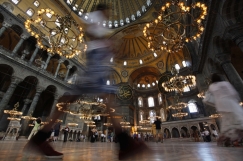
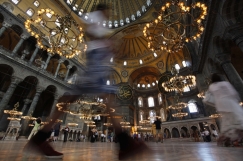
It was quite dramatic. Cardinal Humbert was sent to Constantinople by Pope Leo IX to assert his authority over the Ecumenical Patriarch, Michael Cerularius. According to the Orthodox Christian Information Centre, on a summer afternoon in the stupendous Church of the Holy Wisdom in Constantinople, as a service was about to begin, he and two other papal legates marched up to the altar and placed a Bull of Excommunication on it. On their way out, as he passed through the western door, Humbert shook the dust from his feet with the words: "Let God look and judge." A deacon ran out after him and begged him to take back the Bull, but Humbert refused and it was dropped in the street. Cerularius promptly excommunicated Leo as well.
It does seem like quite a lot to get over, but it was still quite a long time ago.
Theologians have long memories. But other things have happened too. For instance in 1204, the Crusaders decided that instead of having a go at the Holy Land they would sack Constantinople instead. The city was taken amid great slaughter in an event that was regarded as shameful even at the time. Those four lovely horses on St Mark's Church in Venice are loot from Constantinople. Though it later recovered and kicked the Crusaders out, the Byzantine Empire was fatally weakened and couldn't defend itself against the Ottoman Turks who eventually took it in 1430. Orthodox Christians have no reason to feel kindly toward Catholics.
Hang on a second: we are talking about the Russian Patriarch, not the Constantinople one.
Since we are now up to date, you had better call it Istanbul. But you're right. The Ecumenical Patriarch, as he is known, still has the pre-eminent position in the Orthodox world, and Ecumenical Patriarchs and Popes have met before; Francis and Bartholomew met in 2014. But there are now very few Orthodox Christians left in Turkey following a century of massacres and discrimination, and the Patriarchate is a shadow of what it was. The Russian Orthodox Church is by far the biggest and most powerful of all the Orthodox Churches, and that's why this is such an important meeting.
How many Orthodox Churches are there?
Fourteen, but it can depend on who you ask. These are the 'autocephalous', ie self-governing Churches. They are organised on national lines and national tensions and aspirations often have ecclesiastical ramifications; Patriarch Kirill has a big headache at the moment over relations with Ukraine, for instance. The herding cats metaphor is quite appropriate.
Alright, so they'll meet. What's like to come out of it?
In practical terms, very little – see your previous question. Pope Francis is actually notably collegiate in his approach, which is what the Orthodox have wanted for a thousand years, but whether the Roman Catholic Church would ever row back far enough from its traditional assertion of authority – as opposed to primacy – to satisfy them is anyone's guess. And the different Orthodox Churches are at different stages of ecumenical advancement, too. But as long as they get on, it's probably a step in the right direction.
Ah, yes – a journey of a thousand years begins with a single step.
I was going to correct you to 'miles', but judging by the length of time it's taken them to get this far I think you're probably right.
Follow Mark Woods on Twitter: @RevMarkWoods