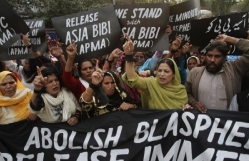
Pakistani Christian Asia Bibi, who is on death row for blasphemy, has been put in solitary confinement over fears that she may be attacked by vigilantes.
Bibi is reportedly being held in a very small, windowless cell in a high security part of her prison in Multan, eastern Pakistan. She has allegedly received threats on her life, following the Supreme Court's decision last month to uphold the death sentence against Mumtaz Qadri, a security guard who murdered governor of Punjab Salman Taseer.
Taseer had publicly spoken against Pakistan's blasphemy laws, and had visited Bibi in prison. He had also filed a mercy petition on her behalf. He was gunned down by Qadri – his own security guard – near his home in Islamabad in 2011.
"She [Bibi] could be killed by any inmate or even a prison guard, so we have to be careful," a prison official told AFP. A second official confirmed that authorities are "concerned for her life".
Bibi was sentenced to death in 2010. She denies charges levelled at her by former colleagues that she insulted the Prophet Muhammad.
In July, hopes were raised that she could be acquitted after the Supreme Court voted to temporarily suspend her execution. Three months later, however, she remains in prison, and is said to be in very poor health.
Pakistan's blasphemy laws are stringently upheld in the country. Those accused of "defiling the Prophet Muhammad" face the death penalty, while life imprisonment is given for damaging the Quran. "Insulting another's religious feelings" can result in up to 10 years in jail.
Human rights groups say the blasphemy laws are frequently misused by extremists, however, and false charges brought against minority groups in order to settle personal scores or to seize property or businesses.
Last year, a Christian couple were beaten and burned to death in a brick kiln following rumours that they had burned pages from the Quran. They were later proved innocent, and 106 people were charged with their murder.
In the State Department's International Religious Freedom Report for 2014 released Wednesday, the Pakistani government was blamed for failing to "investigate, arrest, or prosecute those responsible for religious freedom abuses promoted an environment of impunity that fostered intolerance and acts of violence".
"Government policies did not afford equal protection to members of minority religious groups, and due to discriminatory legislation such as blasphemy laws...minorities often were afraid to profess freely their religious beliefs," the report said.