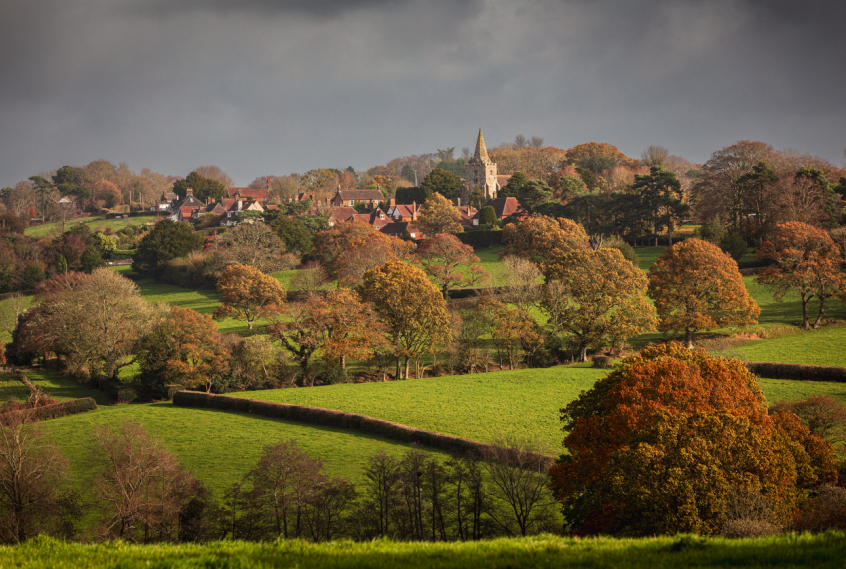
It’s that time of year again. The leaves are changing from green to shades of gold, amber, red and brown. The air is growing colder, daylight is becoming shorter, and the warmth of summer is slowly fading away.
For many of us, autumn carries a strange mixture of beauty and sadness. There is something breathtaking about trees covered in colour, yet those beautiful leaves are also preparing to fall. What was once green and full is slowly being stripped away. Winter is approaching, and with it comes a landscape that can appear bare, dormant and lifeless.
Yet hidden within this changing season is a truth that echoes something Jesus once said about His own death and about the life to which He calls those who follow Him. In John 12:24, Jesus says: “Very truly I tell you, unless a kernel of wheat falls to the ground and dies, it remains only a single seed. But if it dies, it produces many seeds.”
Jesus spoke these words shortly after some Greeks who had travelled to Jerusalem for the Passover festival asked to see Him (John 12:20-21). Their arrival points towards something much greater that was about to happen. Jesus declares that “the hour has come for the Son of Man to be glorified” (John 12:23) - but the glory He speaks of would first lead Him to the cross (John 12:27-28; Mark 10:33-34).
The image He chooses is simple: a seed. A grain of wheat that remains safely in someone’s hand remains only one grain but when it falls into the earth and is buried, something remarkable can happen. What looks like death becomes the beginning of multiplication and new life.
Jesus was speaking, first and foremost, about Himself. He would give His life on the cross so that many could receive life through Him (Mark 10:45; Isaiah 53:11-12). The sinless Son of God would bear sin, suffer death and rise again, opening the way for reconciliation between humanity and God - the means of salvation (Corinthians 5:18-21; 1 Peter 2:24; 1 Corinthians 15:3-4; Romans 5:10).
The cross reveals the extraordinary depth of God’s love for us (Romans 5:8; 1 John 4:10). Christ did not merely speak about sacrificial love; He embodied it (John 15:13; Ephesians 5:2). From taking on human flesh and entering our broken world, to living in humble obedience to the Father, serving others and ultimately laying down His life, Jesus continually poured Himself out (John 1:14; Philippians 2:7). His entire life moved in the direction of self-giving love.
Perhaps this is why autumn can be such a fitting reminder of the gospel. When leaves fall from the trees, our instinct may be to see only what is being lost. Bare branches can look bleak compared with the fullness of summer. Autumn and winter can feel like endings.
But they are not the end of the story. Beneath the surface, life has not disappeared. The seasons continue their course, and in time the seemingly barren branches will bud again. New growth emerges where, for a time, there appeared to be very little life at all.
The Christian life carries something of this pattern. Jesus did not only tell His disciples about the grain of wheat because He wanted them to understand His death. In the verses that follow, He extends the principle to those who would follow Him. “Anyone who loves their life will lose it,” He says, “while anyone who hates their life in this world will keep it for eternal life. Whoever serves me must follow me” (John 12:25-26).
The way of Jesus is therefore also the way of the cross. Christians are not called merely to admire Jesus’ sacrifice from a distance; Jesus calls us to deny ourselves, take up our cross and follow Him (Luke 9:23; Mark 8:34-35; Galatians 2:20). That is much harder.
We often admire sacrifice when we can see the fruit that comes afterwards. We admire missionaries who gave up comfort to serve others, parents who poured themselves out for their children, believers who remained faithful through suffering, or Christians who quietly spent their lives caring for people around them.
But sacrifice rarely feels beautiful while it is happening. Dying to ourselves can mean surrendering our pride when we desperately want to be proved right. It can mean forgiving someone when resentment feels easier. It can mean serving when nobody notices, giving when we would rather keep, staying faithful when obedience is costly, or putting another person’s needs before our own.
Sometimes, following Christ means allowing something in us to fall to the ground: our ambition, our comfort, our desire for recognition, our insistence on having our own way. To the world, and sometimes even to us, such things can look like loss. But the gospel teaches us that surrender to God is not meaningless loss (Matthew 16:25; Philippians 3:7-8). The grain that falls into the ground bears fruit (John 12:24; Galatians 6:9).
It is important to note that Christianity does not ask us to pretend that pain is painless or that loss does not hurt. Rather, the cross shows us that suffering and sacrifice do not have the final word. Resurrection comes after crucifixion.
And the same Jesus who calls us to die to ourselves does not leave us to do so by our own strength. Through the Holy Spirit, God works within us, reshaping our desires and enabling us to live lives of love, obedience and service (Philippians 2:13; Ezekiel 36:26-27; Galatians 5:22-23). Jesus tells His disciples elsewhere that the secret of fruitfulness is to remain in Him: “If you remain in me and I in you, you will bear much fruit; apart from me you can do nothing” (John 15:5). We cannot manufacture this kind of sacrificial life through sheer determination. The fruit comes from abiding in Christ.
The more deeply we know the love that led Jesus to the cross for us, the more freely we can pour ourselves out for others (2 Corinthians 5:14-15; Ephesians 3:17-19). We give because we have first received (2 Corinthians 9:7-8; John 3:16). We love because we have first been loved (1 John 4:19; John 13:34).
Perhaps, then, autumn offers us an invitation. As the leaves loosen from their branches and fall to the ground, we can ask ourselves: what am I still holding onto that Christ is asking me to surrender? Where is He calling me to choose love over self-interest, obedience over comfort, or service over recognition?
There will be seasons in our lives when God seems to be stripping things away. There will be winters when we cannot yet see the fruit He may bring from our obedience. But autumn reminds us that what looks like an ending is not always the end. The leaf falls. The seed enters the earth. Winter comes. And still, God is at work.
We are here today because one perfect life was willingly poured out for many. Jesus Christ, like the grain of wheat, gave Himself so that through His death we might receive life. And now He invites us to follow Him - trusting that a life surrendered to Christ is never wasted.
So, dear reader, as the leaves begin to fall this autumn, do not see them only as a picture of what is passing away. Let them also remind you of the way of Jesus: that sometimes there must be surrender before fruitfulness, dying to self before new life, and the cross before resurrection.
Autumn will give way to winter. Winter will give way to spring. And spring, in time, will give way to summer. The seasons remind us that what looks like an ending may only be the beginning of something new.