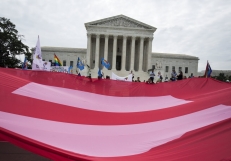
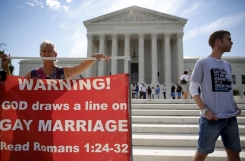
President Barack Obama hailed last week's Supreme Court decision to allow same-sex marriage as a "thunderbolt" but few share his view of gay rights in socially and religiously conservative Africa, which he visits this month.
In most of Africa's 54 states, lesbian, gay, bisexual and transgender (LGBT) people have to hide their sexual orientation for fear of persecution or criminal prosecution. South Africa is the only African country that permits gay or lesbian marriage.
In the streets, churches and corridors of power, from Uganda in the east to Zimbabwe in the south and Nigeria and Liberia in the west, the chorus of homophobic disapproval at the landmark US decision rang out loud and clear.
For many African leaders, whipping up anti-gay sentiment wins popular approval, even when it puts them at odds with the views of Western donors and, according to the World Health Organization, hinders the global fight against AIDS.
Veteran Zimbabwe leader Robert Mugabe has called homosexuals "worse than pigs and dogs". Simon Khaya-Moyo, a spokesman for his ruling ZANU-PF party, said same-sex marriage had no place in Africa.
"It's taboo. We don't even talk about it here," he told Reuters. "Even animals know which is female and which is male. Why should we not be able to know who is female, who is male? It is an insult to God."
Washington has been at the forefront of calls for gay rights in Africa and has led the criticism of its many anti-gay laws, including a recent bill in Uganda that advocated the death penalty for repeated homosexual offences.
For that reason, some African gay rights activists are hoping Obama's visit to Kenya and Ethiopia, beginning on July 25, will help boost their cause.
"Our viewpoint is that President Obama is free to talk about LGBT equality in Kenya," said Eric Gitari, head of the east African country's National Gay and Lesbian Human Rights Commission.
Obama should "show solidarity" with gay activists without appearing to lecture, he added. In May, Deputy President William Ruto said there was "no room" for homosexuality in Kenyan society.
"SODOM AND GOMORRAH"
Medard Bitekyerezo, a Ugandan politician leading the push for tough anti-gay laws, said events in the United States would "invoke more disgust" in the east African country and make domestic legislation against homosexuality more pressing.
"The US Supreme Court's declaration shows the West has become totally disoriented and descended into a Sodom and Gomorrah society," he said, referring to the biblical cities destroyed by God as punishment for their depravity.
"But that's their business - they can't impose it on us."
In Nigeria, a telephone survey of 1,000 people showed that 87 percent of people in Africa's most populous nation supported a ban on gay relationships under a 2014 law that carries a punishment of 14 years in prison.
In the West African state of Liberia, founded in the mid-19th century by freed U.S. slaves, newspapers responded to the US court ruling by writing fearfully of a wave of copycat gay rights activism in their own country.
"Fear is now mounting as to what will happen to this cherished Christian nation," the Evidence newspaper said in an editorial.
In the face of widespread prejudice and danger, Chesterfield Samba, head of Gays and Lesbians of Zimbabwe, said same-sex couples tended to keep their heads down and avoid attention, rather than fighting openly for legal recognition.
"We do not have to wait for the provisions of the law in order for us to be with our partners," he said.
But Clare Byaruhanga of pressure group Chapter Four Uganda said the US court decision showed how societies can change, even when there is a strong conservative Christian tradition.
"I really think the development will send a powerful message," she told Reuters.
"It gives us hope that perhaps one day we'll also triumph and that Uganda will get there. It has taken the US long, but they are there now."