Tony Blair: Yes, Iraq invasion played a part in the rise of Islamic State

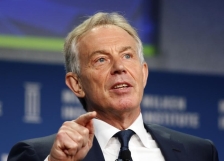
Former British Prime Minister Tony Blair acknowledged the 2003 invasion of Iraq played a part in the rise of the Islamic State militant group, and apologised for some mistakes in planning the war, in an interview broadcast on Sunday.

Blair's decision to send troops to back the US-led invasion is still a live political issue in Britain, where a six-year public inquiry into the conflict is yet to publish its findings.

Asked whether the offensive was the principal cause of the rise of Islamic State, which now controls large areas of Iraq and neighbouring Syria, Blair said there were "elements of truth" in that.

"Of course, you can't say that those of us who removed (former Iraqi dictator) Saddam (Hussein) in 2003 bear no responsibility for the situation in 2015," Blair told US network CNN.

Critics say the US decision to disband Saddam Hussein's army after the invasion created a huge security vacuum exploited by al Qaeda, which was eventually replaced by Islamic State.

Some former Iraqi army officers, members of the Sunni Muslim minority which says it has been marginalised by the Shi'ite-led government backed by Western powers, are senior strategists in Islamic State. The Iraqi government says it has not marginalised Sunnis.

Blair said the "Arab Spring" uprisings across the region also affected Iraq, and pointed out that Islamic State had risen out of a base in Syria, not Iraq.

Blair apologised for what he described as mistakes in planning and intelligence before the war and in preparations for would happen once Saddam was removed, but said it had been the right decision.

"We have tried intervention and putting down troops in Iraq; we've tried intervention without putting in troops in Libya; and we've tried no intervention at all but demanding regime change in Syria. It's not clear to me that, even if our policy did not work, subsequent policies have worked better," he said.

"I find it hard to apologise for removing Saddam. I think, even from today in 2015, it is better that he's not there than that he is there."


related articles
Tony Blair tells Labour: \'Don\'t move to the Left\'
Tony Blair tells Labour: 'Don't move to the Left'

Tony Blair, the Labour Party's most successful election winner, told his party on Wednesday that it could not win power in Britain by lurching to the left.

Jeremy Corbyn says Tony Blair should stand trial if he committed war crime over Iraq

Tony Blair should be tried for war crimes over the 2003 Iraq war if evidence shows he broke international law, Jeremy Corbyn has said.

The vital ingredient missing from the Labour Leadership election...

The absence of a strong Christian Socialist alternative explains why Jeremy Corbyn is confounding expectations, says Andy Walton.

Tony Blair: Islamic extremist ideology supported by Muslims across the world

The idealogy behind ISIS and other extremist Islamic groups has wide support in mainstream Muslim communities, Tony Blair warned yesterday.

News
Wes Huff addresses plagiarism allegations

Scholar Dan McClellan alleged that Wes Huff plagiarized a 2016 Tyndale Seminary paper.

Adult baptisms rise by a third as Church of England sees fifth consecutive year of growth

Adult baptisms in the Church of England have increased by a third in a year, with almost 10,000 adults being baptised in 2025, according to newly published figures.

Not too small for God: how His Kingdom grows through ordinary people

When we look throughout the Bible, from the Old Testament to the New, we discover that God has always worked in unexpected ways, often choosing the very people the world would overlook to accomplish His extraordinary purposes.

Faith in difficult times: lessons from 1930s Britain

Architectural historian Steven Brindle talks to Christian Today about the faith that shaped 1930s Britain, the churches that supported struggling communities and what lessons the decade might have for us today.