The book of Revelation is written in a sort of visionary code which takes a lot of unscrambling. The key to the code has been imagined very differently over the centuries. Some people think Revelation was referring to the events of the time it was written, around AD 95. Others think it provides a symbolic account of the history of the Church during the last 2,000 years or so. Still others – a view particularly popular in the US – believe it is a prediction of the future and that specific world events can be identified in its chapters.
One of the vivid images John uses is in chapter 13, where he talks of beasts rising out of the sea and of the land. Of the second beast he says it was "given power to give breath to the image of the first beast, so that the image could speak and cause all who refused to worship the image to be killed. It also forced all people, great and small, rich and poor, free and slave, to receive a mark on their right hands or on their foreheads, so that they could not buy or sell unless they had the mark, which is the name of the beast or the number of its name.
"This calls for wisdom. Let the person who has insight calculate the number of the beast, for it is the number of a man. That number is 666." (Revelation 13:15-18)
People have always wondered about the "mark of the beast" and the "number of the beast". The "mark" in Greek is charagma, used for seals on documents or designs on coins. When barcodes began to be used on products, some people thought that this was the mark of the beast. Now it's being suggested that we will make transactions and be identified by microchips under our skin; again, some have said that this is the beast's mark.
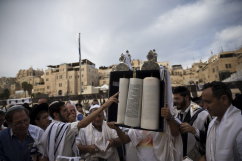
There is nothing very biblical about this sort of speculation, because it's so detached from the world John knew. All we know about prophets indicates that God spoke through their own experience and reflection rather than dropping ideas straight into their heads. This is – like most of Revelation – a mysterious passage, but the likelihood is that the charagma was the head of the Emperor on a coin. It's put in this way to echo the command in Deuteronomy 11:18 to "Fix these words of mine in your hearts and minds; tie them as symbols on your hands and bind them on your foreheads" – a command observed today by Jews who wear phylacteries. So this becomes a warning of the power of a godless economic and political system which seeks to dominate everyone.
And what about the number of the beast, 666? Again, this has been interpreted in all sorts of ways. Sometimes it's identified with the mark, but it appears to be different.
The most likely candidate is the Emperor Nero. Jimmy Akin has a good explanation of this. In New Testament Greek, the language of Revelation, the letters of the alphabet doubled as numbers. The first nine letters of the alphabet stand for one to nine, the next as 10-90 and so on.
Everything that John says about the beast points to an association with Rome and the Roman Empire. In Aramaic, Nero Caesar would have been pronounced something like Neron Qaisar. And if you use the Aramaic numbering system, which works like the Greek, Nero's number adds up to 666.
Furthermore, if you miss off the final N in Neron – an alternative spelling – you get a numerical value of 616. Some early Greek manuscripts give the number of the beast as 616.
This all sounds very convincing, though it's worth noting that Irenaeus, who wrote within a century of John, doesn't mention Nero as a candidate.
But if it was Nero, what does this say to the Church today?
It's another way of warning about the power of a state that is opposed to God. The Bible is ambiguous about the state. In Romans 13 Paul says: "Let everyone be subject to the governing authorities, for there is no authority except that which God has established." But in Revelation – written against the background of Nero's persecution, when the streets of Rome were lit by the bodies of Christians being burned alive for their faith – the state is a ravening beast. It's a dragon; it is "Babylon the great, the mother of prostitutes and of the abominations of the earth" (17:5).
It's likely that John had a particular individual in mind as the beast. In our own time people have identified him with Hitler and Stalin. But if we limit the beast to an individual we are probably missing something important: evil is not just personal, it's corporate and political as well. If even the currency we use to buy food and pay our bills with is tainted, we are faced with all-pervading evil.
The reaction of some Christians to living in a compromised state is to withdraw from it and see it as the enemy. But this is only one way of looking at it; Paul is much more positive. The prophet Jeremiah tells the exiles from Jerusalem to "seek the welfare of the city where I have sent you into exile, and pray to the Lord on its behalf, for in its welfare you will find your welfare" (29:7).
But Revelation's message is clear: the state is also Babylon. We might like living in our own country and even be patriotically proud of it, but our true citizenship is in heaven.