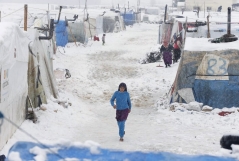
Winter is coming, and so are 600,000 refugees. Many presumed the influx of refugees into Europe would subside as the winter months drew close, but in fact the opposite is proving to be the case. 'Winterization' is intensifying the horrors experienced by refugees across Europe, many of whom are landing on the shores of Greece with no more than the clothes on their back and a pair of flip-flops.
The UNHCR estimates that as many as 5,000 arrivals will reach European shores on a daily basis between November 2015 and February 2016. In total, 600,000 refugees are predicted to make the treacherous journey into and across Europe in these winter months.
Having just returned from the Berkasaovo/Bapska border between Serbia and Croatia, Brenda Yu of World Vision spoke to Christian Today about the realities facing refugees as the savage weather sets in.
At the border crossing, she described seeing "families and children lying lifelessly on the ground with nothing but their thin winter jackets".
"There was an eight-year-old girl, Aya, sat shivering on the ground with her mother. After standing on a boat for 12 hours as it crossed the sea to Greece, she had told her mother she wanted to die, saying 'I just want to die, let me die.'"
A few weeks ago, Aya and her mother embarked on their journey across Europe after their house in Syria was bombed. "From Syria, they drove to Turkey before taking a boat to Greece. Their luggage was drowned along the way and they lost everything. From there, they walked across Greece and Macedonia before finally arriving to Serbia," Yu said.
"My children are psychologically affected, they hate themselves. My Aya wanted to die...she told me she wanted to die after standing for twelve hours before she fainted. She has been up all night throwing up and she's not feeling well. We came out from Syria and we are still suffering," her mother, Rima, told World Vision.
Yu visited refugee camps in Jordan and Lebanon early this year in the midst of winter, where children froze to death, but said "conditions are far worse" now.
"At least in Jordan there were camps, whereas now the refugees have 'informal tented settlements'", she explained. Describing the camps in Jordan as "horrible", she said, "by comparison they were much better, in Serbia they don't even have camps, and there is no designated space for so many refugees.
"100,000 shelters have been promised across the Balkan states, but we need more."
The reality is that many of the refugees are on the move, and winter will not stop them.
As she and her team arrived at the border crossing to Serbia, Yu said that the Berkasoavo crossing was closed and refugee families were told to backtrack in order to get to the train station for an alternative route out of the country.
"Refugees have walked across Turkey, got on boats to Greece, walked across Greece and Macedonia and finally when they arrive at the border of Serbia, are told that the route has changed and they must go to the train station."
People are freezing and exhausted, and with the winter months encroaching, hypothermia, pneumonia and other opportunistic diseases are becoming increasing threats.
Tens of thousands of people, including many unaccompanied children and pregnant women, find themselves imprisoned outside without shelter as the skies darken and night frosts take hold. Temperatures are dropping as low as -9 degrees Celsius.
"The families are fleeing from war and from poverty and they fleeing these places for the hope of Europe, yet what they are facing are totally horrible conditions in Europe," Yu said.
So far this year, more than 3,400 people have lost their lives or been reported missing as they seek to reach the continent.
Today, 11 November, the sixth EU summit was held on the refugee crisis in Malta. Those working with refugees hope that steps will be taken to ensure the effective distribution of warm clothes, stoves, blankets, shoes, and shelter.
The fear, as voiced by Christian Aid's Senior EU Adviser Jenny Brown, is that "The EU has got things the wrong way round".
"It's starting from the premise that all migrants, including refugees, are a problem to be kept away from its borders," she said.
"It should be far more concerned about ensuring that the human rights, safety and dignity of those seeking refuge in the EU are upheld rather than excessively focusing on border control concerns."
In the midst of the suffering, however, there remains a hope.
The Croatian and Serbian governments have coordinated their efforts to ensure refugees can travel between the borders of their two countries by train.
"Never underestimate the determination of the refugee families, who have walked through and gone through things that you and I could never possibly imagine," Yu said.
"I have seen families smiling and being positive when they receive warm coats – I know what we are doing is only a tiny proportion of what is needed, yet it remains that there are hundreds of volunteers there to keep them company as they walk, sing with them, giving a glimpse of the hope found in community."
Though young Aya may have been traumatised by her experiences, Yu said: "I know that she is going to pull through and make it to her safe haven."