'Super-Earth' in outer region of our solar system? Astronomers spot possible ninth planet orbiting sun

Could another planet be revolving around our sun all this time, without us being aware of it?

Using data from the Atacama Large Millimeter/submillimeter Array (ALMA) located in Chile, astronomers were able to spot a faint, distant object in the direction of the Alpha Centauri star system, located in the outer region of the solar system.

This new discovery has fuelled much enthusiasm and speculation among space scientists and enthusiasts.

According to an article on Astronomy.com, the researchers ruled out the possibility that the distant space object was a star, owing to the fact that the ALMA observatory was able to capture low-frequency wavelengths from the new discovery.

Stars do not emit this kind of wavelength, and typically emit too much light for astronomers to spot anything around its vicinity.

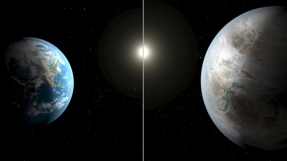
One of the possibilities put forward by the discoverers is that the spotted space object can possibly be a "super-Earth," or a planet with a mass somewhere between that of the Earth's and that of Neptune and Uranus, the two gas giants in our solar system.

In an article on Forbes.com, astrophysicist Brian Koberlein explained that the space object could well be one of the two speculated super-Earths lurking around in the outer solar system.

"One possibility (and I think the most likely) is that it's an extreme trans-Neptunian object about 100 astronomical units (AU) away from the Sun," Koberlein wrote. "Another possibility (which seems more likely to the object's discoverers) is that it is about 300 AU away and about 1.5 times the size of Earth, making it the first 'super-Earth' found in our solar system."

Other members of the scientific community, however, are not convinced that this new discovery will mean another member of our solar system.

Astronomer Mike Brown from the California Institute of Technology, for instance, said that the probability of having a ninth planet in our solar system is just too small.

"The logical leaps are sort of astounding," Brown told the Washington Post. "What they really saw is a little blip and then six months later another little blip."


related articles
European scientists seek to discover, link up with parallel universe through \'miniature black holes\' in space
European scientists seek to discover, link up with parallel universe through 'miniature black holes' in space

Space researchers from European Organization for Nuclear Research, popularly known as CERN, are undertaking a more ambitious, even mind-boggling endeavor: they are seeking not only to discovery, but also to connect with a potential parallel universe.

Space bully? Jupiter may have kicked another planet out of solar system

Astrophysicists at the University of Toronto are floating the idea that the solar system could have had another extra planet, if not for a close encounter with Jupiter.

Bringer of doom on Earth: Comets caused many mass extinctions over the past 260 million years, study finds

For many species that already became extinct, including dinosaurs, death did not come from Earth. It came from above.

A body in our solar system is disintegrating: Mars tearing apart its closest moon Phobos

Phobos disintegrating: Mars tearing apart its closest moon

Pandemonium around Pluto: Four moons orbiting dwarf planet in total chaos

Pluto's four smallest moons are going around the dwarf planet in a totally tupsy turvy way, with one spinning backward and another rotating incredibly fast.

Extraterrestrial life more likely to be found in planets close to each other, says study

A paper written by astrophysicists Jason Steffen of the University of Nevada and Gongjie Li of Harvard's Center for Astrophysics stated that there is a higher likelihood to find alient life in planets very close together.

News
Campaign aims to mobilise 500,000 Christians for Christmas outreach

Shine Your Light is aiming to mobilise half a million Christians to share the gospel with five million people across the UK this Christmas, with more than 2,000 churches already signed up, organisers say.

The Church of England should repent for previous calls to ban 'conversion therapy'

The Church of England's uneasiness about the government's ‘conversion practices’ bill is a perfect lesson in the old adage, 'be careful what you wish for,' writes Dr Martin Davie.

Leaked Home Office report links 'Christian extremism' to traditionalist beliefs and immigration concerns

An internal Home Office report lists concerns about immigration, multiculturalism and changing social values among the characteristics associated with what it calls "Christian extremism", it has been reported.

Tearfund calls for COP31 funding to reach farmers struggling with climate change and food insecurity

Tearfund warns that worsening climate conditions are threatening food production and pushing more people towards hunger.