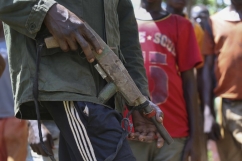
Rebels in the Central African Republic have burned "witches" on a stake in public ceremonies, a leaked United Nations report has claimed.
The report contains graphic photos of victims being lowered over a fire while tied to stakes, as well as the burned torsos of those who suffered this torture. The report was leaked to Thomson Reuters Foundation, a charitable wing of the Reuters news agency.
The 'anti-balaka' militia, who are mainly 'Christian', has been fighting the majority-Muslim Seleka rebels since the latter attempted to take power in 2013. It is now thought that locally held beliefs about witchcraft are being used to exert power.
"Sorcery is firmly entrenched in (Central African Republic) and ... the absence of state authority creates a breeding ground for a sort of popular justice twisted by anti-balakas to its benefit," the researchers said, according to Reuters.
The report cites the case of a Christian pastor who had tried to stop a man being buried alive after being condemned as a witch. "The clergyman was threatened at knifepoint for trying to intervene in matters that did not concern the church," said an eyewitness quoted in the report.
The anti-balaka rebels are also trying to extort money from victims, the report says.
Father Aurelio Gazzera, from Catholic charity Caritas, said the concept of witchcraft was "aggravated during moments of crisis", such as the ongoing violence. "Punishment [of "witches"] is used as a means by an armed group to impose its authority," Gazzera told Reuters. Caritas works in the CAR.
Elections are due to be held in the country on December 27, but there are concerns that violence may escalate in the period leading up to that date. In the CAR, you can be prosecuted for witchcraft by the government.
Sarah Smith, at persecution charity Christian Solidarity Worldwide, said: "The UN have regularly reported on violent attacks on people associated with witchcraft in the CAR."
She questioned calling the anti-balaka rebels 'Christian'. "Christians on the ground do not want to be associated with the anti-balaka rebels, they are a criminal armed group. The rebels are taking advantage of the weak State... People are being extorted and threatened with violence. The anti-balaka group is trying to establish its position through violence, to take advantage of the security vacuum in the country."
Smith said that the UN Peacekeeping Mission in the country has a Human Rights division, which has been gathering evidence on these allegations. The information would be passed to the justice system, but it would then be up to the CAR's justice system to bring the perpetrators to court.