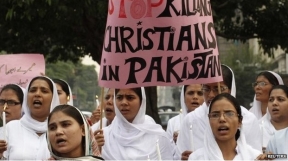
Suicide bombings outside two churches in Lahore killed 14 people and wounded nearly 80 others during services on Sunday in attacks claimed by a faction of the Pakistani Taliban.
Sunday's attacks occurred minutes apart in a majority Christian suburb of the eastern city. Police said they targeted two churches, one Catholic and one Protestant, that are very close to each other.
Islamist militants in Pakistan have attacked Christians and other religious minorities often over the past decade. Many Christians accuse the government of doing little to protect them, saying politicians are quick to offer condolences after an attack but slow to take any concrete steps to improve security.
Following the blasts, enraged residents lynched two men they suspected of involvement, a police official said.
Protesters also began smashing up shops and attacking vehicles. Police and several politicians were chased from the scene, residents said.
Witnesses said more bloodshed in the bombings was prevented by security guards and police assigned to the churches. Four died tackling the attackers.
"I was sitting at a shop near the church when a blast jolted the area. I rushed towards the spot and saw the security guard scuffle with a man who was trying to enter the church. After failing, he blew himself up," witnessAmir Masih said.
Another witness, Akram Bhatti, said: "I was present outside Christ Church when I saw a young man in his early 20s wearing black clothes. He was stopped by the guard. The attacker exploded the suicide vest."
Fourteen people were killed and 78 wounded in total, said Zahid Pervaiz, provincial director of general health.
The Taliban faction Jamaat-ul-Ahrar claimed responsibility.
Lahore is the capital of Punjab, Pakistan's wealthiest and most populous province and the political heartland of Prime Minister Nawaz Sharif.
The city is generally considered peaceful compared with many other areas of Pakistan, but violence there has been increasing after the government's failed attempts to hold peace talks with the Taliban last year.
After the talks failed, the military launched an offensive in the remote northwestern region of North Waziristan along the Afghan border to push the Taliban from the last major region they controlled.
The military now holds the major urban centers there, but residents say many militants fled before the offensive began and others remain in rural areas.