
Many Olympic venues are already achieving iconic status - but one about to enter the public's consciousness already has an illustrious history.
The Salvation Army-owned Hadleigh Farm in Essex will play host to the Games' mountain biking event. It will be the first time an Olympics event has been hosted on land owned by the Salvation Army.
The commercial farm is more than 120 years old and is continuing the work started by William Booth in helping unemployed or marginalised members of society to retrain and find employment.
Comprising 600 acres of crop and 300 acres of organic grassland with a highly-regarded tea room and farm shop, it also houses a training centre to help people with special educational needs learn subjects such as IT and carpentry.
Back in the 1930s it provided refuge firstly for Basque children fleeing the Spanish Civil War, and then at the end of the decade accommodation for nearly 70 Jewish refugees fleeing persecution in Germany and Eastern Europe.
It's quite a place, and Ivor Telfer, chair of the Salvation Army's Olympic Task Force, said the denomination was delighted to help when LOCOG came calling.
"LOCOG were looking for an appropriate venue for the mountain biking, and were looking to keep it close to London," he explained. "They had contact with Essex County Council, who came to have a look at Hadleigh and said 'How would you feel about offering your farm to LOCOG?'
"We said yes, we want to support the Olympics, so let's sit down and talk. It's been really interesting, encouraging and exciting.
"It's just been great working with Essex County Council, helping to make sure this Olympic event goes off really, really well."
Working around the farm's usual commercial and training ventures - it provides wheat for Hovis and malt for Maltesers among other things - LOCOG has installed and prepared a track in readiness for the event on August 11/12.
It is of Olympic standard ("very steep in places", notes Ivor) and has delighted both the farm's employees and trainees, despite the extra workload.
"We think it's been really worth it," Ivor said. "Full credit must go to the people who are working on the land, who are trying to harvest crops and look after trainees.
"There's been a lot of work. But talking to the trainees, they say it's been great for them. They've had senior government and LOCOG officials come out. They are all just delighted. That's certainly one of the important things for us - the trainees getting excited and having some good opportunities to see some world class sporting events."
And as the Salvation Army has offered its facilities to the Olympic cause, there will naturally be a legacy. Plans are in place to maintain the farm as a mountain bike venue, with the Salvation Army in negotiations with LOCOG to develop new tracks after the Games. It is also looking at putting in a new tea room at that end of the farm, which is around a mile away from the existing tea room, and there is the possibility of a family center.
'We are really encouraging families to come here,' Ivor said. 'All the research we have done suggests there is a vast amount of people in a 20 mile radius who would love to come along and do mountain biking.'
Thanks to the Olympics they look set to get that opportunity.




-

UN officials demand explanation for Iranian church seizure
-

AI could become a ‘very dangerous master’, warns John Lennox
-
Archbishop of Canterbury withdraws award given to Muslim cleric who praised Bin Laden
-

Calls for Church of England to be 'rooted in scripture' ahead of General Synod elections
-

Most practising Christians are evangelical, study finds
-
Church of England blessing same-sex relationships 'a bridge too far'
Most Popular
News

People view religious education positively, study finds
The government is consulting on plans to add RE to the national curriculum.
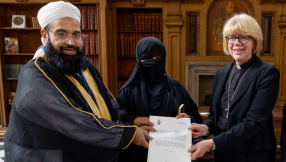
Archbishop of Canterbury withdraws award given to Muslim cleric who praised Bin Laden
Reform leader Nigel Farage said the decision to award Hafiz Muhammad Tahir Mehmood Ashrafi was "astonishing".
How the new General Synod could move beyond the present disagreement over same-sex relationships
How might the next Synod make progress in the next five years based on a recognition that there are those in the Church of England who hold fundamentally opposed positions on the matter? Is there a way of allowing both sides to achieve what they want? Martin Davie argues that the answer to this question is ‘Yes.’
No part of London should become a free speech, gospel exclusion zone
Soho is not exempt from freedom of speech and Christian expression. And Christians do not lose their fundamental freedoms when they cross an invisible boundary into a neighbourhood associated with a different worldview. The streets of London belong to all of us, writes Andrea Williams.








