A senior priest and Arab Christian from the Middle East has called on the West not to attempt to defeat Islamic State by bombing. He predicted the organisation will instead destroy itself from within.
Rev Dr Michel Jalakh aged 48, from Beirut, who is secretary general of the Middle East Council of Churches and a Maronite Catholic, said more use should instead be made of the region's Christians who speak Arabic and have lived as neighbours and friends of Muslims for centuries.
At grass-roots level, he said, the existence of Islamic State had not damaged Christian relations with Muslims, and most Muslims opposed it. He called on the West not to judge Islam through the actions of Islamic State.
"We have lived with Muslims since the beginning. We have been with Muslims all the time. ISIS has not changed our point of view. We know that IS is exceptional. This movement is something many Muslims are against.
"Unfortunately they are now very strong. There are many people who help them. I am not saying ISIS is not Islamic, we know they have their black flags. But it is not the true Muslim religion. We cannot make decisions or judge the Muslim religion based on ISIS."
Speaking to Christian Today during a visit to London, he said a lack of justice in the Arab world contributed to radicalism. There were many kinds of Islam, so it was not right to judge the whole of Islam on ISIS. In addition, there were additional political considerations that had nothing to do with religion.
"We as Christians are in dialogue with Islam. We want to help Muslims be themselves against movements such as ISIS. It is not a question of having a coalition of Western countries to bomb ISIS. They will take it as crusaders, or West against East, white against black. We have to avoid all these kinds of judgements. They are good for movies but not reality."
Islamic State was a question for the Islamic religion, and Muslims had to fight it from the inside. "We are facing a momentous era. I think this ridiculous thing will disappear sooner or later from the inside. We are seeing that socially, inside themselves, they have many problems. I am sure it will die sooner or later."
He said the West needed to try to understand the complexities of the region better. The answer was to make more use of Christians in the region, through bodies such as the Middle East Council of Churches. "We know Arabic, we know the Koran, we live with Muslims in the same villages and cities. We look for common values together."
The Middle East Council of Churches, an ecumenical organisation based in Beirut, Lebanon, represents all Christian denominations across the Middle East and North Africa, including Catholic, Orthodox, Anglican and Protestant and evangelical churches. Its four co-Presidents are the heads of the Syriac Catholic, Greek Orthodox, Armenian Orthodox and Lutheran churches.
Fr Jalakh was speaking at a time of devastating decline in the number of Middle Eastern Christians. Besides low birth rates, the present persecution and terror in countries such as Iraq is contributing to a mass emigration of refugeees. The region's 12 million Christians are expected to have halved in number by 2020.
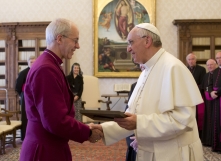
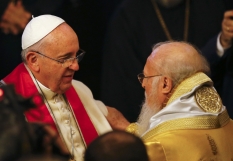
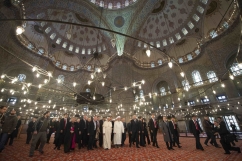
On his recent visit to Istanbul in Turkey, Pope Francis said: "We cannot resign ourselves to a Middle East without Christians who have professed the name of Jesus there for 2,000 years."
Fr Jalakh said: "I am a priest, I believe in God and in Jesus Christ. I know that Jesus chose that land to be born in. He said, 'I will be with you forever, do not be afraid.' It is not the first time Christians there have had a really hard time.
"Now it is easy to emigrate. For the future, we alway have hope. As Christians and church leaders we have to give hope always that beyond what is happening, there is peace. We have to work for justice for everyone, not only Christians and Muslims. I believe we have a future there.
"We are diminishing in numbers which is difficult but still, it is not a question of number, it is a question of being there to be a symbol of hope through a presence. It would be a pity for humanity if all that land was to be without Christianity. It is a difficult time. It is easy to talk about but difficult to live. We all have to work for peace."
Not just Christians but Muslims were also leaving. "We have a role there, to dialogue for humanity and to avoid a clash of civilisations. It is a question of creating a new era, a new way of thinking."