Latin is undergoing a revival with courses taking place in some of England's finest cathedrals for participants aged 12 to over 80, the Guardian has reported.
At least six cathedrals have already this year run short courses in Latin, while St Alban's Cathedral is preparing for two-week long summer schools in Latin and New Testament Greek and Gloucester Cathedral is planning several weekend courses in the coming months.
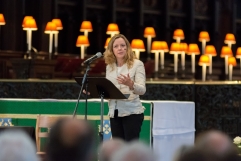
Gloucester Cathedral tutor George Sharpley, who has also taught beginners' classes in Latin at Lincoln, Southwark, Chichester, Exeter and Ely cathedrals, told the Guardian: "I'd been reading about Charlemagne and the Latin schools he started in cathedrals and monasteries 1,200 years ago. It seemed a good time to echo that." He taught 11 day courses in the first four months of this year. "One was quiet, but at the rest we had to turn people away," he said. "It was a step into the unknown, but the response has been pretty good. I get very excited about Latin, so I'm not surprised others do too."
Describing the participants, Sharpley added: "There are retired people and young people. Some have never learned any Latin. Many are simply curious."
Clare Coombe, the adult learning officer at St. Alban's Cathedral and a classicist, found a similar range of participants taking part in a five-week course of evening classes that ended last week and included a 12-year-old and several people who were not native English speakers. She said: "I was surprised at the mix of nationalities – French, German, Croatian. But Latin is part of our European heritage. Sometimes people are interested because they've heard Latin said at mass or they want to be able to read inscriptions on tombs in the cathedral. And people who are not generally good at languages are often quite good at Latin."
Sharpley's one-day beginners' courses begin with the Latin roots of English words but "[by lunchtime, they're able to read a line or two of Virgil," he said.
However, he adds, "the Latin of Ovid and Virgil was a language to be heard, not studied in books in solitude. It's a very lively language, one for the ear. It makes a connection, it turns lights on. Every few minutes, someone has an 'aha' moment when they realise Latin is part of our language today."