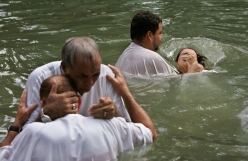
Q. I'm from a non-church background. I became a Christian after an evangelism course and was baptised, but now I'm wondering what's next. Life seems a bit flat and there's a sense of, 'Is this it?'
A. It's not surprising if there's been a bit of a come-down since your conversion. For those who come to faith from a non-church background, there's often a sense of something huge happening. You have the support of your pastor and your church up to your baptism, but then there can be a feeling of anti-climax and of being left to get on with your Christian life by yourself. If you feel like this, it might be worth mentioning it to your minister. However, there are a few things it might be worth saying.
1. This is normal! Maybe it helps to think of becoming a Christian as being like courtship and marriage. There's a gradual process of getting to know someone, realising that you like them and then that you love them and want to spent the rest of your life with them. The moment that's acknowledged (perhaps with the traditional ring-on-bended-knee offer) is like the moment you decide to be a Christian. After that there's the anticipation of preparing for the wedding, which is like your baptism. But after that, the work of marriage begins. Marriage is sometimes exciting, sometimes boring, sometimes hard and sometimes just ordinary. If it were at the same emotional pitch as a wedding every day we wouldn't be able to cope.
2. Don't treat Christian faith as a sort of college course. At the moment you're very conscious of everything you don't know, and perhaps you have a feeling that everyone else knows more than you. Church culture is probably still a bit weird and you're still working out why your church does what it does. The Bible is a long and complicated book, with lots in it that you don't understand. Reading and study can help with that, but here's the thing: Christianity is not about what you know, it's about who you know. You will meet lots of really saintly people who don't know much about doctrine or how church works, but who have spent a lifetime getting to know God. Make that your priority.
3. Don't be obsessed by church. You're learning a lot, you've met new and interesting people and you want to find out more about your new faith. But you're also a person with wider interests. You might like books, music and going out with friends. You might have a career that interests you and that you want to make a success. So yes, you should be committed to your church, but Christian discipleship isn't about letting church take over your life: it's about learning to see Christ and show Christ in everything you do. Live a full life, rich in experiences, and praise God for them.
4. Don't pay too much attention to how you feel. If you've been moved by what you've seen in the gospel and if living as a Christian fills you with joy, that's great. Some people are more emotional than others. But your faith shouldn't rest on what you feel. You're a Christian because you believe Christianity is true, not because it makes you feel good. So learn the discipline of doing. Go to church when you don't feel like it. Read the Bible when you don't understand it. Pray when you can't see the point. That's what Christians do. (By the way, not everyone is good at finding their own words to say. Even if it's not something your church generally does in public worship, consider finding a book of prayers and using them to pray, or reading a Psalm, or saying the Lord's Prayer. It can really help.)
5. Keep your eyes on the prize, not on the pathway. The early Christians spoke of their faith as the 'Way'. We can get discouraged and depressed by the difficulties we face as we journey through the Christian life. We don't always understand things, other Christians are often really irritating and sometimes we just wonder what it's all about. We also face the normal stuff that goes wrong for everyone – very few people live lives that are purely happy. But there are no short cuts: faith is life-long and we have to take the rough with the smooth. Clement of Alexandria, who lived in the second century AD, wrote this: "We may not be taken up and transported to our journey's end, but must travel thither on foot, traversing the whole distance of the narrow way."
You are just at the beginning of your journey to what John Bunyan called "The Celestial City". But God will help you all the way.
Follow @RevMarkWoods on Twitter.