Hello Pluto! US spacecraft makes closest contact with Solar System's farthest planet

After nine and a half years journeying in outer space, a National Aeronautics and Space Administration (NASA) spacecraft made history on Tuesday by making the closest contact with the dwarf planet Pluto, the farthest planet ever reached by a human probe.

NASA's New Horizons spacecraft made its historic flyby of the 2,370-km-wide Pluto at 7:49 a.m. ET, going within 7,767 miles of what used to be regarded as our Solar System's ninth planet.

New Horizons flew at a speed of 14 km per second to be able to reach Pluto in almost a decade, making it the fastest NASA spacecraft ever. It also passed by Jupiter in 2007.

New Horizons' flyby of Pluto marked another milestone in the history of space exploration, completing a tour by spacecraft from Earth of all nine objects considered as planets in our Solar System.

Alan Stern, the chief scientist of the NASA's mission to Pluto, said his entire team is proud to have made this accomplishment.

"We have completed the initial reconnaissance of the Solar System, an endeavour started under President Kennedy more than 50 years ago and continuing to today under President Obama," Stern said.

"It's really historic what the US has done, and the New Horizons team is really proud to have been able to run that anchor leg and make this accomplishment," he added.

NASA has released the most detailed photo of Pluto to date, showing an almost complete view of the brown dwarf planet.

NASA's science chief, John Grunsfeld meanwhile said the Earth can now have more knowledge about Pluto after New Horizons' historic flyby.

"This is true exploration... that view is just the first of many rewards the team will get. Pluto is an extraordinarily complex and interesting world," Grunsfeld said.

Stern, for his part, said space scientists can now study Pluto's surface and its history.

"You can see regions of various kinds of brightness. Very dark regions near the Equator, very bright regions just to the north of that, broad intermediate zones over the pole. What we know is on the surface we see a history of impacts. We see a history of surface activity," he said.


related articles
Glass deposits found on Mars: Life \'conveniently bottled\' on Red Planet?
Glass deposits found on Mars: Life 'conveniently bottled' on Red Planet?

In what could be a pivotal step towards the study of whether life existed on Mars, space scientists from the National Aeronautics and Space Administration (NASA) recently made an unexpected discovery on the surface of the Red Planet: glass deposits.

New human species may develop if space colonisation happens, experts say

Astronomy professor Chris Impey from the University of Arizona believes that human beings will morph into another species once they leave the familiar environment of the Earth where they used to live in.

\'Hello Earth\': Comet lander Philae wakes up after months of hibernation
'Hello Earth': Comet lander Philae wakes up after months of hibernation

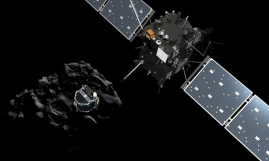
As if waking up from a long, deep slumber, the world's first ever comet lander has once again made contact with its team back on Earth after months of hibernation.

Pyramid on Mars: Natural rock formation or signs of alien life?

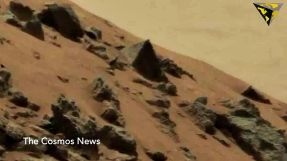
We know that there are ancient pyramids on Earth, but could these structures also exist on Mars? Enthusiasts of extraterrestrial life believe they do.

Alien life on comet? Data from 2 probes shows signs of ancient living organisms

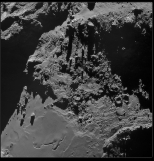
Leading astronomers are now focusing their attention on images of organic-rich black crust captured by Philae on the comet 67P/Churyumov-Gerasimenko. These are believed to be indications that signs of ancient living organisms are present beneath the comet's icy surface.

Doomsday fears vanish as giant asteroid buzzes past Earth 270,000 miles away

On July 7, an asteroid called 2015 HM10 came close to the Earth, triggering some to worry about possible doom. As it turned out, the asteroid did not lead to world destruction some feared about.

News
Campaign aims to mobilise 500,000 Christians for Christmas outreach

Shine Your Light is aiming to mobilise half a million Christians to share the gospel with five million people across the UK this Christmas, with more than 2,000 churches already signed up, organisers say.

The Church of England should repent for previous calls to ban 'conversion therapy'

The Church of England's uneasiness about the government's ‘conversion practices’ bill is a perfect lesson in the old adage, 'be careful what you wish for,' writes Dr Martin Davie.

Leaked Home Office report links 'Christian extremism' to traditionalist beliefs and immigration concerns

An internal Home Office report lists concerns about immigration, multiculturalism and changing social values among the characteristics associated with what it calls "Christian extremism", it has been reported.

Tearfund calls for COP31 funding to reach farmers struggling with climate change and food insecurity

Tearfund warns that worsening climate conditions are threatening food production and pushing more people towards hunger.