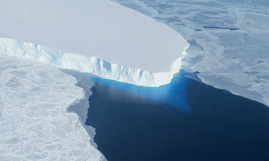
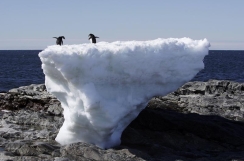
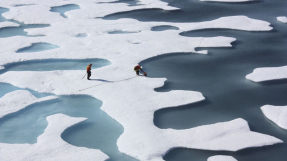
Greenland, the biggest island in the world, has lost a tremendous amount of ice which covers three quarters of its land mass over the past century, and the melting continues up to this day.
An extensive new research conducted by 16 scientists recently quantified the amount of ice that the Greenland ice sheet has lost since the year 1900, and the figure is simply staggering: 9,103 gigatons, a unit equivalent to a billion metric tons.
The team of researchers, led by Kristian K. Kjeldsen of the Natural History Museum of Denmark at the University of Copenhagen, came out with this tremendous figure after carefully studying the distinct marks left by retreating glaciers on the landscape.
The massive research project, results of which were published in the journal "Nature," also entailed extensive aerial photography and satellite observation on Greenland.
"It's the first observational-based study that shows where Greenland has lost its mass over the last 110 years," senior study author Kurt H. Kjær from the Natural History Museum of Denmark at the University of Copenhagen told The Washington Post.
The same study also found out that the amount of ice Greenland lost in the period 2003 to 2010 was twice compared with what it was throughout the 20th century.
"We find that 2003–2010 mass loss not only more than doubled relative to the 1983–2003 period, but also relative to the net mass loss rate throughout the 20th century," the study noted.
The research specified which parts of Greenland accounted for much of the ice loss: the northwest and southeast of the ice sheet, as well as at Jakobshavn glacier in the southwest, Greenland's single fastest moving glacier.
These areas alone account for 25 to 35 gigatons of ice Greenland loses annually.
According to the research, there are basically two ways Greenland is losing ice. The simpler, more popularly known method involves the melting on the surface of the ice sheet, the runoff of which ends up into the ocean.
The second method—the lesser known but more dangerous one—involves large ice-release events at marine-based glaciers, which causes the outward flow of ice and can even trigger huge earthquakes due to the movement of gigaton-sized icebergs.