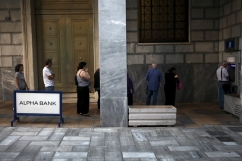
Greeks queued outside banks on Monday as they reopened three weeks after closing to stop the system collapsing under a flood of withdrawals, the first cautious sign of a return to normal after a deal to start talks on a new package of bailout reforms.
However, capital controls will remain and payments and wire transfers abroad will still not be possible – a situation which German Chancellor Angela Merkel said on Sunday was "not a normal life" and warranted swift negotiations on a new bailout.
The stock market will also remain closed until further notice.
Queues formed outside bank branches in central Athens as people waited to take care of business frozen during the three week-long bank holiday.
Limits on cash withdrawals have been made slightly more flexible, with a weekly limit of 420 euros in place of the daily 60 euro limit previously.
"Capital controls and restrictions on withdrawals will remain in place but we are entering a new stage which we all hope will be one of normality," said Louka Katseli, head of the Greek bank association.
Greeks will be able to deposit cheques but not cash, pay bills as well as have access to safety deposit boxes and withdraw money without an ATM card.
Bankers said there may be minor disruptions after the three-week interruption to services but they expected services to resume largely as normal.
"I don't expect major problems, our network and the network of our competitors are ready to serve our clients," said a senior official at Piraeus Bank, one of the big four lenders. "There might be lines because many people will want to withdraw money from their deposit boxes," the official said.
The bank closures were the most visible sign of the crisis that took Greece to the brink of falling out of the euro earlier this month. But Tsipras is eyeing a fresh start and swift talks on the bailout that will keep Greece afloat.
The tough terms of the bailout will see tax hikes, pension cuts, strict curbs on public spending, an overhaul of collective bargaining rules and a transfer of 50 billion euros of state assets into a special privatisation fund.
In exchange, Greece is hoping to receive loans of up to 86 billion euros.
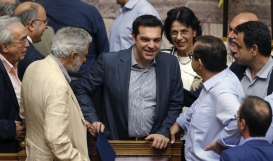
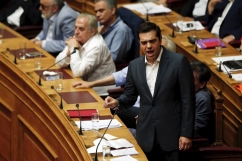
The decision to reopen banks was the first action by Greece's new cabinet after the 40-year-old leftist prime minister sacked rebels who had opposed the deal he struck with EU leaders last week.
Increases in value added tax agreed under the bailout terms have also taken effect with VAT on food and public transport jumping to 23 per cent from 13 percent.
Acceptance of the bailout terms that meant the banks could reopen marked a turnaround for Tsipras after months of difficult talks and a referendum that rejected a less stringent deal proposed by the lenders.
He sacked party rebels in a government reshuffle on Friday and is seeking a swift start to talks on the bailout accord with European partners and the IMF before elections which Interior Minister Nikos Voutsis said were likely in September or October.