German lawmakers risk Turkey's wrath with Armenia 'genocide' vote

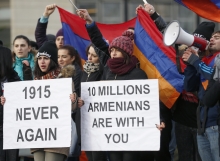
German lawmakers risk angering Turkish President Tayyip Erdogan and jeopardising an EU-Turkey migrant deal by backing a planned resolution branding as "genocide" the mass killings of up to 1.5 million Armenians by Ottoman Turkish forces a century ago.

The vote, expected to be held in the first week of June, comes at a particularly sensitive time, with German Chancellor Angela Merkel keen to ensure that Erdogan remains committed to implementing the migrant deal she has championed.

Critics accuse her of going soft on Turkey over human rights because she is desperate to stem the flow of migrants to Germany. She drew fire from critics for allowing a German court to go ahead with investigations against a comedian whom Turkey wants charged for mocking Erdogan in a sexually crude poem.

Merkel's conservatives, their junior coalition partner the Social Democrats and the opposition Greens are finalising the wording of the largely symbolic resolution.

Conservative Franz Joseph Jung said the term "genocide" would be in both the headline and the text of the resolution.

"We want to contribute to reconciliation but I think we want to correctly describe a historic fact," he told Deutschlandfunk radio on Tuesday, adding it was separate from the migrant deal.

Turkey denies that the massacres, which took place as Ottoman and Russian forces fought in the east of the Ottoman Empire, constituted genocide. It argues that the there was no organised campaign to wipe out the Armenians, who are Christian, and no evidence of any such orders from the Ottoman authorities.

Turkey's ambassador to Germany, Huseyin Avni Karslioglu, has already criticised the move.

"It's not the job of national parliaments to judge history," he told the Rheinische Post daily.

There are also fears that the resolution could stir tensions with the some 3.5 million people of Turkish origin who live in Germany.

Last year, German President Joachim Gauck condemned the killings of Armenians as genocide in a speech to mark the 100th anniversary of the massacres. Germany had previously avoided using the word 'genocide' to describe the killings.

Lawmakers then discussed a resolution but there was no vote and the parties have been working on the text since then.

related articles
Armenian killings were genocide, says World Evangelical Alliance – and Turkey should admit it

Armenian killings were genocide, says World Evangelical Alliance – and Turkey should admit it

Head of Armenian Church files lawsuit to get back cathedral seized by Turks in genocide

Head of Armenian Church files lawsuit to get back cathedral seized by Turks in genocide

Pope to visit Armenia after angering Turkey with genocide remark

Pope to visit Armenia after angering Turkey with genocide remark

Armenian migrants in Turkey fear tense political climate

Armenian migrants in Turkey fear tense political climate

News
Pope seeks prayers for peace in Christmas Day message

The Pope asked people to pray in particular for the "tormented people of Ukraine" in his Christmas Day 'Urbi et Orbi' message. 

Who was St Stephen and why is he remembered on December 26?

The carol says, “Good King Wenceslas last looked out on the Feast of Stephen.” In many countries, December 26, also known as Boxing Day, is better known as St Stephen’s Day. Stephen was the first Christian martyr. This is the story …

King Charles reflects on pilgrimage, reconciliation and hope in Christmas Day address

King Charles III used his Christmas Day speech to reflect on the significance of pilgrimage as he appealed to the nation "to cherish the values of compassion and reconciliation". 

2 Timothy 3:16 is Logos' Bible verse of the year, Matthew was the most studied book

One of the most-studied Bible verses of the year is from 2 Timothy in the New Testament, according to an analysis of millions of Bible study sessions that tracked how believers worldwide are engaging with Scripture.