
|PIC1|Christianity has long been stereotyped as a Western, white man's religion, but a prominent theologian believes that image will soon drastically change.
"The new face of Christianity will be the black woman," said Dr Kwok Pui Lan to an audience at Lexington Theological Seminary in Kentucky, according to the Lexington Herald-Leader. Kwok, a professor at the Episcopal Divinity School in Cambridge, Massachusetts, is a pioneer in Asian feminist theology as well as postcolonial theology.
Kwok explained that as of last year, Europe still had the largest number of Christians in the world - 532 million. It is followed by Latin America with 525 million and then Africa at 417 million.
But by 2025, Africa is projected to shoot up to 634.6 million Christians, followed closely by Latin America at 634.1 million, while Europe will fall to 531 million Christians.
The United States had 223 million Christians mid-2007 and is predicted to grow slightly to 252 million by 2025.
"The challenge is to re-imagine Christianity in the 21st century," said Kwok, who is the William F Cole professor of Christian Theology and Spirituality at the Episcopal Divinity School.
In 1900, over 80 per cent of all Christians were from Europe and North America, but by 2005 the number was under 45 per cent, observed Dr Todd Johnson, director of the Center for the Study of Global Christianity at Gordon-Conwell Theological Seminary, in his 2006 report entitled USA evangelicals/Evangelicals in a Global Context.
Johnson had noted that the number correlated with new data that revealed a southern shift in Christianity away from the UK and US.
Offering an explanation for Christianity's boom in Africa, the Rev Dr Samuel Kobia - the first African General Secretary of the World Council of Churches - said late last year that Christianity is not seen as a "part-time" occupation in Africa in comparison to the US, but rather "permeates the whole life".
"Christianity in Africa, sub-Saharan Africa especially, is seen not only as a religion, but this is the opportunity of people to contribute to national building, to peace and reconciliation, to development," said Kobia at Washington National Cathedral in December. "Therefore the church becomes the center of activity."
Besides discussing Christianity's southern shift, Episcopal Divinity's Kwok also explored the post-colonial world after World War II, when many colonies became independent.
In her lecture entitled "Globalization and the Challenge to Christianity", Kwok contended that globalisation provides opportunities to advance religion, and religion can offer societies a common value system such as human rights. But globalisation also presents obstacles to religion, including a counter movement that resorts to violence to retain their beliefs and identities.
Kwok was the guest speaker at The William Daniel Cobb II Lectures at Lexington Theological Seminary. The special lecture began in 1990 in memory of the seminary's 12th president, inviting a distinguished speaker on theology to the seminary each year.



-

Wycliffe celebrates ‘remarkable moment’ as Bible translation advances at rapid pace
-

Could the Church face a ‘silver uprising’?
-

From Tyndale to today: The enduring hunger for the Bible
-

500 million Christians worldwide face Bible access restrictions, report finds
-

800 years on: Why St Francis of Assisi still captivates the world
-
More than 4,200 Christians killed in Nigeria this year - report
Most Popular
News
Blackburn Cathedral puts the Bible where it belongs
Blackburn Cathedral’s celebration of William Tyndale highlights the Bible’s central place in Anglican worship.
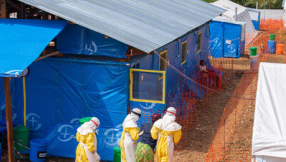
Anglican bishop reminds world that Ebola is still gripping DRC
Ignorance and poverty have compounded the effects of Ebola.

Rights groups call for review of laws impacting free speech
The government supports your right to agree with it.

Scottish Greens' call for total decriminalisation of abortion denounced
The Greens have called upon the SNP government to move forward with the recommendations of the Scottish Abortion Law Reform Expert Group.








