A new Church of England paper calling on Christians to help heal growing divisions sees an increasingly important role in modelling “a healthy sense of patriotism” while resisting both nationalism and political polarisation.
The report, "Promoting Unity in Our Nation", has been drafted by the Bishops’ Working Group and will be discussed by members of the Church of England's General Synod when it meets in York from July 10 to 14.
Chaired by the Bishop of Leicester, Martyn Snow, the working group examines the causes of social fragmentation and sets out the Church's role in fostering stronger communities at a time of “acute” divisions.
The report identifies five priorities for the Church: practising humility, encouraging an inclusive form of English patriotism, recognising the dignity of every person, building relationships across social and cultural divides, and forming active citizens equipped to contribute to public life.
It says churches should be places where people from different backgrounds encounter one another, learn civic responsibility, and develop the skills needed to participate constructively in society.
Among the practical suggestions are encouraging churches to host community celebrations, strengthen relationships with people of different faiths, support civic participation, and create opportunities for meaningful encounters across social divisions.
“Parish churches can play a very significant role in hosting community celebrations. And there is no reason why these celebrations should not focus on pride in our nation — as long as this is done in a way which includes everybody, is honest about our history, and does not seek to be triumphalist,” the report reads.
The report calls for an honest reckoning with the Church’s own history, including its links to the transatlantic slave trade and more recent safeguarding failures, arguing that humility must underpin its public witness.
It points to widening wealth inequality, the decline of traditional civic institutions and community organisations, increasingly fractured media consumption, and the demonisation of minority groups as key factors driving social division.
It also cites research linking financial insecurity with people feeling “like a stranger in my own country.”
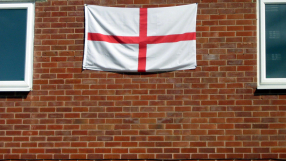
Despite this, the report argues there are reasons for optimism. It cites research suggesting large majorities of people believe English identity should be open to people of every ethnic background, support expressions of national pride that clearly reject prejudice, and view the St George’s flag as a symbol shared by people of all ethnicities and faiths.
“While some churches have been reluctant to fly the St George's flag in the current climate, others have taken the opportunity to explain why the flag can still be a sign of unity,” the report says.
“Appropriate explanation and interpretation can draw on St George's background and martyrdom, as well as highlighting the importance of symbols and rituals in uniting people. As the established church, we should model a healthy sense of patriotism.”
It concludes that there is a “substantial and largely silent majority” seeking a more inclusive understanding of English identity, with the Church “uniquely placed” to help give it a voice. The Church, it says, has a role to play in telling a “healthier” national story that involves “honesty” and “not glossing over the wrongdoing and injustice carried out in the nation’s name or within its bounds, but also celebrating our nation’s achievements and progress”.
“Second, it would be particular without being exclusive: cherishing what is characteristic about England and its people, without assuming uniqueness or drawing hard lines around who truly belongs.
“Third, it would be oriented toward the common good rather than collective self-interest: it would ask not only what the nation can achieve for those within its borders, but what responsibilities it bears toward the wider world,” it reads.
The bishops’ report also cautions against confusing the nation with the Kingdom of God and says the Church must maintain a “critical distance”.
“Perhaps the most important point to note is the danger of conflating our understandings of nation, church and kingdom,” it says.
“The kingdom of God is our ultimate horizon, and both the church and the nation stand under its judgement and promise. To identify the kingdom with the church is to fall into triumphalism. To identify the kingdom with the nation is to baptise national interest as divine will. To identify the church with the nation, after the manner of the high Christendom settlement of the sixteenth century, is to deprive the church of the critical distance from which it must speak.”
Elsewhere it recommends that Christians should not withdraw from public life but instead work for the common good, peace and reconciliation.
The report comes against the backdrop of growing public dissatisfaction with Britain's institutions.
Citing polling by More in Common, it notes that the word most commonly used by respondents to describe Britain was “broken,” followed by “divided,” “struggling” and “mess.” It also found that 87% of Britons had “little to no faith in politicians.”
The paper is accompanied by a theological address delivered to the College of Bishops in January 2025 by Oxford theology professor Luke Bretherton, which provides much of the theological framework underpinning the report.
Professor Bretherton argued that Christians should reject both narratives that portray Britain as wholly shameful and those that present it as uniquely glorious.
“All political communities are contingent and fallen. None are innocent,” he told the bishops, drawing on St Augustine's City of God.
Instead, he said, Christians should tell “a Christian story” in which Britain is “neither innocent nor uniquely evil” but “a fallen political community in which God has nonetheless been at work.”
He warned that national identity becomes distorted when either political ideology seeks to claim ultimate authority. Rather than promoting either patriotic triumphalism or national self-condemnation, he argued that the Church should tell “a story of grace and disgrace” that acknowledges both achievements worthy of gratitude and wrongs requiring “repentance and repair.”
Professor Bretherton similarly argued that political communities should not be defined primarily by ethnicity, race or culture. Instead, he proposed understanding Britain as “a demos: a people assembled in this land from many places, crafting through politics a shared arena of just and generous common life through which can be realised moral goods.”
Concluding his address, Professor Bretherton urged bishops to avoid speaking of “national identity” or “English values,” instead encouraging language centred on shared responsibility.
“Speak instead of duties of care and shared goods. England is a civic not a cultural or religious project, one to which all may contribute, and for which all bear responsibility,” he said. “That is the story the Church is called to tell - truthfully, penitentially, hopefully, and lovingly - in the light of Christ.”