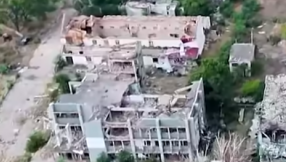
As the evacuation of rebel-held areas of Aleppo got under way today, ambulances came under fire from fighters loyal to the Syrian government resulting in the death of at least one person, according to a rescue service spokesman.
But other buses and ambulances later started moving into rebel-held areas of the city under a deal to evacuate civilians and fighters following rapid advances by government forces. The Russian defence ministry said the evacuation of 5,000 rebels and their family members had begun.
The evacuation of Aleppo's last rebel enclave could end years of fighting for the city and mark a major victory for Syrian President Bashar al-Assad.
"[Pro-government fighters] fired at us and at ambulance vehicles and those people opening up the road," a rescue service spokesman told Reuters.
A witness in nearby government-held territory heard a burst of gunfire that lasted several minutes.
An official with an Aleppo rebel group said the medical convoy had stopped before clearing the besieged eastern part of the city.
Another group of ambulances, and more than 20 buses, began to move towards the rebel-held area of Aleppo.
"Thousands of people are in need of evacuation, but the first and most urgent thing is wounded, sick and children, including orphans," said UN humanitarian adviser for Syria Jan Egeland.
A Reuters witness in government-held territory said columns of black smoke could be seen rising from rebel-held area.
Residents hoping to be taken out have been burning personal belongings they cannot take with them. "Outside every building you see a small fire, papers, women's clothes," one resident told Reuters.
Russian soldiers were preparing to lead rebels out of Aleppo, the defence ministry in Moscow said. Syria had guaranteed the safety of rebels and their families, who would be taken towards Idlib, a city in north-western Syria.
Russia would use drones to monitor how rebels and their families were transported on 20 buses, accompanied by 10 ambulances, along a humanitarian corridor, the ministry said.
A truce brokered by Russia, Assad's most powerful ally, and opposition backer Turkey on Tuesday broke down following renewed fighting on Wednesday and the evacuation did not take place then as planned.
An official from the Jabha Shamiya rebel group said a new truce came into effect at 2.30am on Thursday.
Shortly before the new deal was announced, clashes raged in Aleppo.
Government forces made a new advance in Sukkari - one of a handful of districts still held by rebels - and brought half of the neighbourhood under their control, according to the Syrian Observatory for Human Rights, a monitoring group.
The Russian defence ministry said – before the report of the government forces' advance in Sukkari – that the rebels controlled an enclave of only 2.5 square km.
The evacuation plan was the culmination of two weeks of rapid advances by the Syrian army and its allies that drove insurgents back into an ever-smaller pocket of the city under intense air strikes and artillery fire.
By taking control of Aleppo, Assad has proved the power of his military coalition, aided by Russia's air force and an array of Shi'ite militias from across the region.
Rebels have been backed by the US, Turkey and Gulf monarchies, but that support has fallen far short of the direct military assistance given to Assad by Russia and Iran.
Russia's decision to deploy its air force to Syria 18 months ago turned the war in Assad's favour after rebel advances across western Syria. In addition to Aleppo, he has won back insurgent strongholds near Damascus this year.
The government and its allies have focussed the bulk of their fire-power on fighting rebels in western Syria rather than ISIS, which this week managed to take back the ancient city of Palmyra, once again illustrating the challenge Assad faces re-establishing control over all Syria.
Carla del Ponte, a United Nations investigator and former UN war crimes prosecutor, told the German newspaper Die Zeit that Russian and Syrian bombing of homes, hospitals and schools amounted to war crimes, as did the starving out of parts of Aleppo for months by militias loyal to the government.
Additional reporting by Reuters.