Turks began voting on Sunday amid worsening security and economic worries in a snap parliamentary election that could profoundly impact the divided country's trajectory and that of President Tayyip Erdogan.
The parliamentary poll is the second in five months, after the ruling AK Party founded by Erdogan failed to retain its single-party majority in June.
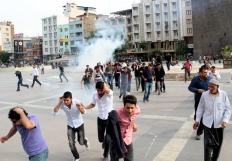
Since then, a ceasefire with Kurdish militants has collapsed into bloodshed, the Syria crisis has worsened and NATO-member Turkey has been hit by two Islamic State-linked suicide bomb attacks, killing more than 130.
There has been little sign of the flags, posters and campaign buses that thronged the streets in the build-up to June's vote, but Erdogan has framed this sombre re-run as a pivotal opportunity for Turkey to return to single-party AKP rule after months of political uncertainty.
"This election will be for continuity of stability and trust," he said after praying at a new Istanbul mosque on Saturday. He vowed to respect the result.
Early voters in Istanbul were sharply divided in their views on a return to single-party rule or the prospect of a coalition.
"The AK Party says single-party rule will bring stability but we haven't seen much of it in the last couple of years," said 22-year-old nurse Gulcan. "We need a system of checks and balances and a grand coalition will hopefully give us that."
"Coalitions are just not good for Turkey. There has to be single-party rule for stability," said 51-year-old Kahraman Tunc, voting with his wife and daughter. "For the sake of our country's good I hope there will be AK Party single-party rule."
Voting began in eastern Turkey at 7 am local time and an hour later in the rest of the country, with polling stations to close at 1400 GMT. A ban on announcing the results is in place until 1800 GMT but the election board usually lifts the ban before the official time.
The election was prompted by the AKP's inability to find a junior coalition partner after the June result. Erdogan's critics say it represents a gamble by the combative leader to win back enough support so the party can eventually change the constitution and give him greater presidential powers.
Many polls suggest that while support for the centre-right, Islamist-rooted party may have inched up, the outcome is unlikely to be dramatically different to June, when it took 40.9 per cent of the vote.
However, one survey released on Thursday suggested there had been a late surge in support for the AKP and that it could take as much as 47.2 per cent, comfortably enough to secure more than half of the 550-seat parliament.
Deep polarisation
Whatever the outcome, deep polarisation in Turkey – between pious conservatives who champion Erdogan as a hero of the working class, and Western-facing secularists suspicious of his authoritarianism and Islamist ideals – is likely to remain.
"The political uncertainty, growing social divisions and insecurity which has characterized the period between the two elections seems set to continue," Bulent Aliriza, director of the Turkey Project at the Washington-based think-tank CSIS, said in a note on Friday.
If the AKP fails again to secure a single-party majority, it may be forced back to the negotiating table with either the main secularist CHP opposition or the nationalist MHP.
Some Western allies, foreign investors and Turks see a coalition with the CHP as the best hope of easing sharp divisions in the EU-candidate nation, and say it could keep Erdogan's authoritarian instincts in check.
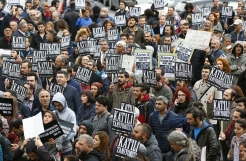
Raids in recent days on opposition media linked to Erdogan's arch enemy, US-based cleric Fethullah Gulen, including the closure of two TV stations and seizure of newspapers, have heightened fears about the erosion of freedom of speech and the rule of law.
AKP officials are hoping the uncertainty and insecurity of recent months will steer voters who remember the fragile coalition governments of the 1990s back to the AKP, and are betting a recent crackdown on the outlawed Kurdistan Workers' Party (PKK) will claw back nationalist votes.
Investors and Western allies hope the vote will usher in stability and shore up confidence in the economy, allowing Ankara to play a more central role in stemming Europe's migrant crisis and helping in the fight against Islamic State.
Turkey jets bombed Islamic State (IS) targets in Syria on Saturday ahead of the election and state-run Anadolu Agency said more than 50 IS militants were killed.