Turkey's government has said that Islamic State was the prime suspect in suicide bombings that killed at least 97 people in Ankara, but opponents vented anger at President Tayyip Erdogan at funerals, universities and courthouses.
The father of three men wounded in the blasts told Reuters one of his sons had described seeing one of the bombers carrying a bag on his back and one in his hand, and called out "stop" before the bomb detonated.
Prime Minister Ahmet Davutoglu said Saturday's attack, the worst of its kind on Turkish soil, was intended to influence the outcome of November polls Erdogan hopes will restore a majority the ruling AK party lost in June. Officials say there is no question of postponing the vote.
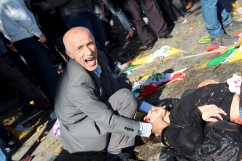
Two bombs struck seconds apart, targeting a rally of pro-Kurdish activists and civic groups near Ankara's main train station.
"If you consider the way the attack happened and the general trend of it, we have identified Islamic State as the primary focus," Davutoglu told Turkey's NTV television. "It was definitely a suicide bombing...DNA tests are being conducted. It was determined how the suicide bombers got there. We're close to a name, which points to one group."
The Haberturk newspaper has cited police sources as saying the type of explosive and the choice of target pointed to a group within Islamic State known as the 'Adiyaman ones', a reference to Adiyaman province in southeastern Turkey.
Turkey is vulnerable to infiltration by Islamic State, which holds swathes of Syrian land abutting Turkey where some two million refugees live. But there has been no word from the group – usually swift to publicly claim responsibility for any attack it conducts – over the Ankara bombing or two very similar incidents earlier this year.
Opponents of Erdogan, who has led the country over 13 years, blame him for the attack, accusing the state at best of intelligence failings and at worst of complicity by stirring up nationalist, anti-Kurdish sentiment.
The government, facing a growing Kurdish conflict at home and the spillover of war in Syria, vehemently denies such accusations.
But the sheer range of possible perpetrators – from Islamic State and Marxist radicals to militant nationalists and Kurdish armed factions – highlights deep fissures running through Turkish society. At stake is the stability of a NATO country seen by the West as a bulwark against Middle Eastern turmoil.
Protests
Hundreds chanting anti-government slogans marched on a mosque in an Istanbul suburb for the funeral of several of the victims, attended by Selahattin Demirtas, leader of the pro-Kurdish parliamentary opposition Peoples' Democratic Party (HDP), which says it was the target of the bombings.
Riot police with water cannon and armoured vehicles stood by as the crowd, some chanting "Thief, Murderer Erdogan" and waving HDP flags, moved towards the mosque in the working class Umraniye neighborhood of Istanbul.
Several labour unions also called protests. Hundreds of people, many wearing doctors' uniforms and carrying Turkish Medical Association banners, gathered by the main train station in Ankara where the explosions happened to lay red carnations but were blocked by riot police, a Reuters witness said.
Lawyers at an Istanbul courthouse chanted "Murderer Erdogan will give account" as colleagues applauded, footage circulated on social media showed.
Erdogan, accused by opponents of an increasingly authoritarian and divisive style, has overseen a purge in the judiciary of elements he believes to have been colluding with a US based cleric-rival planning a coup against him.
Syria spillover
The HDP has put the death toll from the bombings at 128 and said it had identified all but eight of the bodies. Davutoglu's office has said 97 were killed.
The bombs struck as hundreds gathered for a march organised by pro-Kurdish activists and civic groups to protest over a growing conflict between Turkish security forces and Kurdistan Workers Party (PKK) militants in the southeast.
The PKK is deemed a terrorist group by the United States and the EU as well as Turkey. Some 40,000 have been killed in the predominantly Kurdish southeast since the insurgency began in 1984.
The father of three men wounded in the blasts said one of his sons, Abdulselam, described seeing one of the bombers carrying a bag on his back and one in his hand. He called out "stop" suspecting an attacker.
"The bomber panicked. Selam got nervous and acted without thinking. Maybe he could have had the chance to get him arrested, but he shouted to the bomber," the father, Mehmet Ali Altun, told Reuters outside the hospital where his sons were being treated. The son, who had been questioned by police, declined to speak to media.
The HDP accused Ankara of escalating violence to try to reduce its vote at November 1 polls, restore an AK majority and pave the way for the more powerful presidential system Erdogan seeks.
The Ankara attack revived memories of a similar bombing of a pro-Kurdish rally in the southeastern town of Diyarbakir and another in Suruc in July that killed at least 30 and was also attributed to Islamic State. There was no claim of responsibility and HDP says there was no proper investigation.
"Our electorates feel under constant threat in every social space and political activity they attend," it said.
In comments reflecting the murky entanglements that exist in Turkish political thinking, the HDP also accused the AKP of relying on radical groups including Islamic State as proxies to fight Kurds in northern Syria. The government strongly denies such suggestions.
Tensions have further unnerved investors, many of whom have reduced their Turkey exposure in recent months because of the election uncertainty. The lira weakened to 2.95 to the dollar early on Monday, making it the worst performing currency among major emerging markets.
AK Party spokesman Omer Celik told reporters the party was suspending its rallies until Friday. Demirtas said he no longer thought large rallies were possible amid the security fears but that it would be up to the HDP to decide.