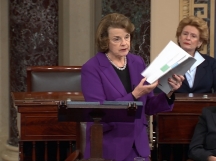
CIA director John Brennan said on Thursday some agency officers used "abhorrent" methods on detainees captured following the September 11 attacks and said it was "unknowable" whether harsh interrogation techniques yielded useful intelligence.With his agency under fire in the aftermath of a US Senate report detailing the CIA's use of torture on detainees after the 2001 attacks, Brennan rejected the report's conclusion that the agency had deceived the White House, Congress and the public about its interrogation programme.
"Our reviews indicate that the detention and interrogation programme produced useful intelligence that helped the United States thwart attack plans, capture terrorists and save lives," Brennan told a news conference at the agency's Virginia headquarters.
"But let me be clear. We have not concluded that it was the use of EITs (enhanced interrogation techniques) within that programme that allowed us to obtain useful information from detainees subjected to them," Brennan said.
"The cause-and-effect relationship between the use of EITs and useful information subsequently provided by the detainee is, in my view, unknowable," he added.
The programme was run under President George W Bush. Senior officials from that administration have defended the methods, which President Barack Obama barred when he took office in 2009. Former Vice President Dick Cheney said in 2009 the methods were "absolutely essential in saving thousands of American lives and preventing further attacks against the United States".
Brennan made an appeal to move on from the controversy over past CIA actions.
"We know we have room to improve," Brennan said.
"In light of the fact that these techniques were abandoned seven years ago, however, my fervent hope is that we can put aside this debate and move forward to focus on issues that are relevant to our current national security challenges," he added.
The Intelligence Committee's report found that the CIA acted more brutally and pervasively than it has acknowledged.
Some captives were deprived of sleep for up to 180 hours, at times with their hands shackled above their heads, and the report recorded cases of simulated drowning, or "waterboarding," and sexual abuse, including "rectal feeding" or "rectal hydration" without any documented medical need.
"In a limited number of cases, agency officers used interrogation techniques that had not been authorized, were abhorrent and rightly should be repudiated by all. And we fell short when it came to holding some officers accountable for their mistakes," Brennan said.
Brennan said the "overwhelming majority of officers involved in the programme at CIA carried out their responsibilities faithfully and in accordance with the legal and policy guidance they were provided".
The Senate committee concluded that CIA, through torturing al Qaeda and other captives in secret prisons worldwide between 2002 and 2006, did not obtain information it could have gotten through non-coercive means enabling it to disrupt a single al Qaeda plot.
CHAIN OF COMMAND
Brennan was a senior CIA official when the interrogation programme was put in place. He acknowledged he had some knowledge of the agency's involvement in harsh interrogations and running secret prisons. "I was not in the chain of command. I did not have authority over the implementation of that programme or the management oversight of it," he said.
Brennan said the CIA believes information from detainees subjected to enhanced interrogation eventually helped the United States track down al Qaeda chief Osama bin Laden, killed in a 2011 US raid in Pakistan. Brennan conceded it was uncertain whether the same intelligence could have been obtained without such methods.
Brennan said that non-coercive methods are available to elicit useful information from detainees that will not impact national security or international standing.
Asked whether he considered some of the methods used by CIA interrogators to be torture, Brennan said he would leave it to others to place labels on what occurred.
Brennan noted that the CIA was directed by Bush to carry out a programme to detain terrorism suspects around the world after the 2001 attacks. "We were not prepared," Brennan said.
Brennan said he believes the use of "coercive methods has a strong prospect for resulting in false information" because the detainee may say anything simply to get the methods to stop. He noted the CIA maintains the methods yielded both "useful" and "false" information.