This is a problem that some churches in the increasingly-secular West must dream of sharing.
Christianity is growing so fast and so noisily in parts of Nigeria that the authorities are actually having to shut churches down - to secure peace and quiet for local residents.
And it is not just churches. Mosques too are being closed in a clampdown on noise pollution. Places of worship are being sacrificed as part of a plan to make Lagos free of noise pollution in just four years.
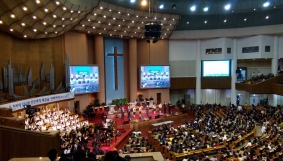
Many Nigerian churches are in enormous buildings, are well resourced, employ thousands of staff and have large robed choirs full of singers that could give most X Factor contestants a run for the top prize. They hold joyous worship celebrations with loud, compelling gospel music, often accompanied by live bands, that last for hours.
The churches being shut down, however, are generally those meeting in make-shift buildings where there has been little attempt made to sound-proof buildings and services.
Bola Shabi, general manager of Lagos State Environmental Protection Agency, said that 70 churches, 20 mosques and about 11 hotels, club houses and beer parlours had been closed. Another problem in the city is blaring car horns.
"We've been so strict now that we are not going to even allow make-shift churches in the state any longer.
"What I mean by make-shift, using tents and uncompleted building, we are not going to allow that any further in the state."
He said mosques, where the call to prayer is broadcast from minarets by loudspeaker, were more compliant than churches, and most would reduce the noise level as soon as they were asked.
"Enforcement is a continuous exercise and we have set a target for ourselves. We want to ensure that Lagos is noise-free by the year 2020. With our status as a mega city, by year 2020 we will be free of noise,'' he told Vanguard.
More than 100 people died in 2014 when a building owned by televangelist TB Joshua collapsed in Lagos.
The population of Lagos, currently nearly 18 million, is expected to double by 2050. Already more than 85 million Nigerians are Christian, more than half country's total population, and more than 18 million of these are Anglican. Numbers are growing fast and steadily, giving the devoutly evangelical province growing influence in the worldwide Anglican church on issues such as sexuality.
Archbishop and primate of Nigeria, Nicholas Okoh, is currently chairman of the conservative Anglican grouping Gafcon.