The death toll in the attack by Somali Islamists on a university in northeastern Kenya on Thursday has risen to 147 and the siege has ended, the country's disaster response agency said.
"UPDATE: 147 fatalities confirmed in the Garissa Attack," The Kenya National Disaster Operation Centre said on its official Twitter feed, adding that the operation had ended.
==========================
Islamist militant group al Shabaab stormed a university campus near Kenya's border with Somalia, taking Christian students hostage and battling security forces over several hours.
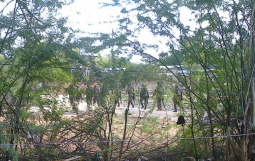
Police and soldiers surrounded and sealed off Garissa University College and were attempting to flush out the gunmen, the head of Kenya's police force, Joseph Boinet, said.
Al Shabaab, which has links to al Qaeda and a track record of raids on Kenyan soil, claimed responsibility for the pre-dawn attack, in which scores were wounded.
Sheikh Abdiasis Abu Musab, the group's military operations spokesman, said it was holding many Christian hostages inside.
"We sorted people out and released the Muslims," he told Reuters. "Fighting still goes on inside the college."
"The attackers shot indiscriminately while inside the university compound," Boinet said in a statement, adding police had been guarding the university's four hostels at the time.
At least 14 people had been killed, a policeman at the scene said, while the Red Cross said 50 students had been freed.
Others managed to escape the compound unaided.
"We heard some gunshots and we were sleeping so it was around five and guys started jumping up and down running for their lives," an unnamed student told Reuters TV.
Sixty-five people were wounded, the country's National Disaster Operation Centre said on its Twitter feed. Four had been airlifted to Nairobi for treatment.
"We have 49 casualties so far, all with bullet and (shrapnel) wounds," said a doctor at Garissa hospital.
CHRISTIANS AND MUSLIMS
Al Shabaab, which seeks to impose its own harsh variant of sharia law, had separated Muslims from Christians in some of its previous raids in Kenya, notably late last year in attacks on a bus and at a quarry.
Its repeated raids, together with attacks on churches by home-grown Islamist groups, have in recent years strained the historically cordial relations between Kenya's Muslim and Christian communities.
Thursday's attack also marked a setback in a drive by President Uhuru Kenyatta to persuade foreigners the country is safe to visit.
On Wednesday, he urged Kenyans abroad to help woo tourists back despite the wave of militant violence, criticising a warning from Australia of a possible attack in Nairobi and an advisory from Britain urging its citizens to avoid most coastal resorts.
Kenyatta was due to address the nation about the Garissa attack later on Thursday.
Grace Kai, a student at the Garissa Teachers Training College near the university, said there had been warnings that an attack in the town could be imminent.
"Some strangers had been spotted in Garissa town and were suspected to be terrorists," she told Reuters.
"Then on Monday our college principal told us ...that strangers had been spotted in our college... On Tuesday we were released to go home, and our college closed, but the campus remained in session, and now they have been attacked."
Al Shabaab had previously carried out attacks in Garissa, which lies around 200 kilometres (120 miles) from the porous Somali border.
Many Kenyans living in the crime-ridden frontier regions blame the government for not doing enough to protect its citizens from the militants.
Having declared it would punish Kenya for sending troops into Somalia to fight it alongside African Union peacekeepers, it was also responsible for a deadly attack in 2013 on the upscale Westgate shopping mall in Nairobi.