
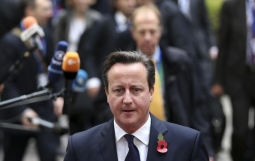
Britain's continued membership of the European Union depends upon it being allowed to stop migrants from the bloc tapping into its relatively generous welfare system, Prime Minister David Cameron said today.
Cameron has said that he wants EU migrants in work to have to wait four years before they can access welfare benefits and for unemployed EU migrants not to be eligible for any help from the British state at all.
With polls showing that immigration is voters' top concern ahead of a General Election next year, Cameron is under pressure to take a tougher line on the issue. Many Conservatives increasingly fear the rise in popularity of UKIP, which this month won its second seat in parliament.
The speech is likely to upset EU partners such as Poland which has suggested such measures would be discriminatory. But Cameron will not call the EU's freedom of movement rules into question as some EU leaders had feared. He will not advocate migrant quotas or an "emergency brake" on incoming migrants.
If re-elected, he has previously promised to renegotiate Britain's ties with the EU before giving Britons an in/out membership referendum in 2017.
He will make it clear today that he thinks his renegotiation will succeed. But he will also drop his strongest hint yet that he may campaign for Britain to leave the EU if he fails.
"I will negotiate a cut to EU migration and make welfare reform an absolute requirement in renegotiation," Cameron will say, according to advance extracts released by his office.
"If I succeed, I will, as I have said, campaign to keep this country in a reformed EU. If our concerns fall on deaf ears and we cannot put our relationship with the EU on a better footing, then of course I rule nothing out."
If implemented, his proposals, which are designed to make Britain a less attractive place for migrant labour, would affect over 300,000 EU migrants, many of them working in low-wage low-skilled jobs.
In the proposals, welfare payments to EU migrants' children living outside Britain would be stopped and jobless EU migrants would be removed if they were unable to find work within six months.
Nationals from member states joining the EU in future would also be banned from joining the British labour market until their home economies had converged more closely with current members.
Such changes would require the agreement of other EU states and possibly necessitate a change to the bloc's founding treaties, something most countries are reluctant to do.
Under the EU's freedom of movement rules, EU citizens are entitled to work anywhere in the bloc. That has seen hundreds of thousands of EU nationals come to work in Britain, which has the bloc's fastest-growing economy.
Figures published on Thursday showed 228,000 EU citizens had moved to Britain in the year to June alone -- the highest recorded figure -- adding political pressure on Cameron to act.
UKIP and parts of the Conservative party say the public is unhappy about what it perceives to be abuse of the welfare system by unemployed EU migrants and is worried that those migrants who do find jobs are depressing wages.
Britain has already cut access to social security payments for EU migrants this year, tightening the eligibility criteria, increasing the waiting period before migrants are entitled to payments, and halving the length of time for which they can claim unemployment and child benefits.
Cameron is expected to say he wants his proposed changes to apply to the whole of the EU. Failing that, he will say he wants a UK-only settlement.




-

Edinburgh University ends divinity programmes as theology faces a changing future
-

Why the Archbishop of Canterbury’s award controversy matters
-

More than one in four US Protestant churchgoers believe some biblical truths become outdated
-

Catholicism in France has 'collapsed'
-

Christian leaders issue ‘sober and urgent call’ for Western Church to prepare for disruption
-

Australia's anti-therapy laws harm the most vulnerable - Britain should not copy them
Most Popular
related articles
MPs criticise UK's immigration 'mess'
MPs criticise UK's immigration 'mess'
The myth of the undeserving poor
The myth of the undeserving poor
UKIP is 'anti-everything': John Major
UKIP is 'anti-everything': John Major

Foodbank users rise by 40%, people 'living on financial knife edge'
Foodbank users rise by 40%, people 'living on financial knife edge'
News

Active faith linked to happier marriages and lower divorce rates, study finds
People who regularly attend church are more likely to report happy marriages, according to a new report examining the relationship between faith and family life.

Indian churches fearing anti-conversion laws tell non-Christians: enter at your own risk
Churches in Dhamtari, a town in the central Indian state of Chhattisgarh, have put up notices warning non-Christians that they enter at their own risk, weeks after a law against religious conversion came into force in the state.

£1k bursaries to help churches develop youth and community mentoring programmes
Churches across the UK are being offered bursaries to help them establish mentoring programmes aimed at supporting young people and others in their communities.

World Evangelical Alliance celebrates 180th anniversary
The World Evangelical Alliance (WEA) has held an online celebration to mark its 180th anniversary. Hundreds of people from more than 22 countries attended, and the event was rebroadcast to accommodate different time zones.








