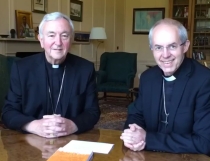
The Archbishop of Canterbury laid into Donald Trump as un-Christian and irrational in front MPs on Tuesday as he answered questions on migration and asylum seekers.
Justin Welby also attacked the "inexcusable" UKIP leader Nigel Farage for "legitimising racism" as he became the first Church of England head to give evidence before the home affairs select committee.
The Anglican primate was grilled on topics that ranged from his position on the European Union and whether he thought Britain was too full to accept any more migrants, to his thoughts on Sharia law and antisemitism.
But his most strident comments were directed at the presumptive Republican nominee and Farage. Welby said he agreed with Pope Francis when he said "anyone who only builds walls and not bridges is not a Christian".
On Trump's plans to ban Muslims from entering the United States, Welby added: "It is certainly not a Christian thing to do nor is it a rational thing to do. It does not respect the dignity of the human being."
The 90-minute questioning began with Keith Vaz, Labour MP and chair of the committee, asking Welby about Nigel Farage's comments to the Sunday Telegraph over the weekend. The UKIP leader warned attacks on women on a mass scale would happen if people from outside Europe gained access to EU passports and entered the UK.
Vaz said: "I would regard those comments as being racist and a lot of people would. What's your take on what he has said?"
The head of the C of E said he agreed and "utterly condemned" Farage.
"I think that is an inexcusable pandering to people's worries and prejudices.
"That's giving legitimisation to racism, which I've seen in parishes in which I've served and has led to attacks on people in those parishes. And we cannot legitimise that."
However the Archbishop stood by his comments in March that it was legitimate to fear mass migration.
"We never serve ourselves well when we neglect fear," Welby told MPs. "The answer to fear is not to say it is improper to fear but to recognise it and the causes of that fear."
He added: "I fully accept there is a burden on communities. The answer to that burden is one has to provide specific extra resources to communities affected."
But Welby denied that Britain was too full and said Britain could take more migrants.
"We can take more people in but have to think very, very hard about doing it," he cautioned. "You can do the right thing in such a wrong way it becomes the wrong thing."
Earlier on Tuesday the Bishop of Durham, who answered questions alongside the Archbishop, publically supported Britain remaining in the EU. However despite numerous attempts from the committee of MPs, Welby refused to give an indication of his views.
"You're quite good at this," Vaz joked as Welby ducked a series of questions attempting to establish his position on the EU.
The Archbishop was equally cautious on the topic of Sharia law. His predecessor Rowan Williams caused outrage in 2014 when he was reported as supporting the introduction of aspects of Sharia law in Britain.
Welby told MPs that Williams' remarks had been "widely misreported" but refused to comment any further on Williams' views. On the use of Sharia law in Britain, Welby said: "We have laws in this country that are drawn from international sources such as civil law and roman law... Whatever sources you draw from, the basic philosophy of English jurisprudence must always prevail under all circumstances."
The lively session concluded with Vaz promising to write to Welby to prize a fuller answer out of him on Sharia law.